Is now a good time to run?
Run Score right now: New York City 85 London 66 Los Angeles 88 Sydney 68 Tokyo 96
Free running weather calculator. Type your city and get the Run Score for right now and the best hour today, from the same engine as the app.

- ★★★★★5.080+ ratings
- 2,500+runners
- 100countries
 Works with Apple Health
The app
One check a day, done for you
When to go
Every hour gets a Run Score. On this Austin day the best was 7 am at 94.
Why it feels hard
Tap any hour: what's against you and how much slower the same effort runs.
On your home screen
Widgets and a morning alert, no app to open.
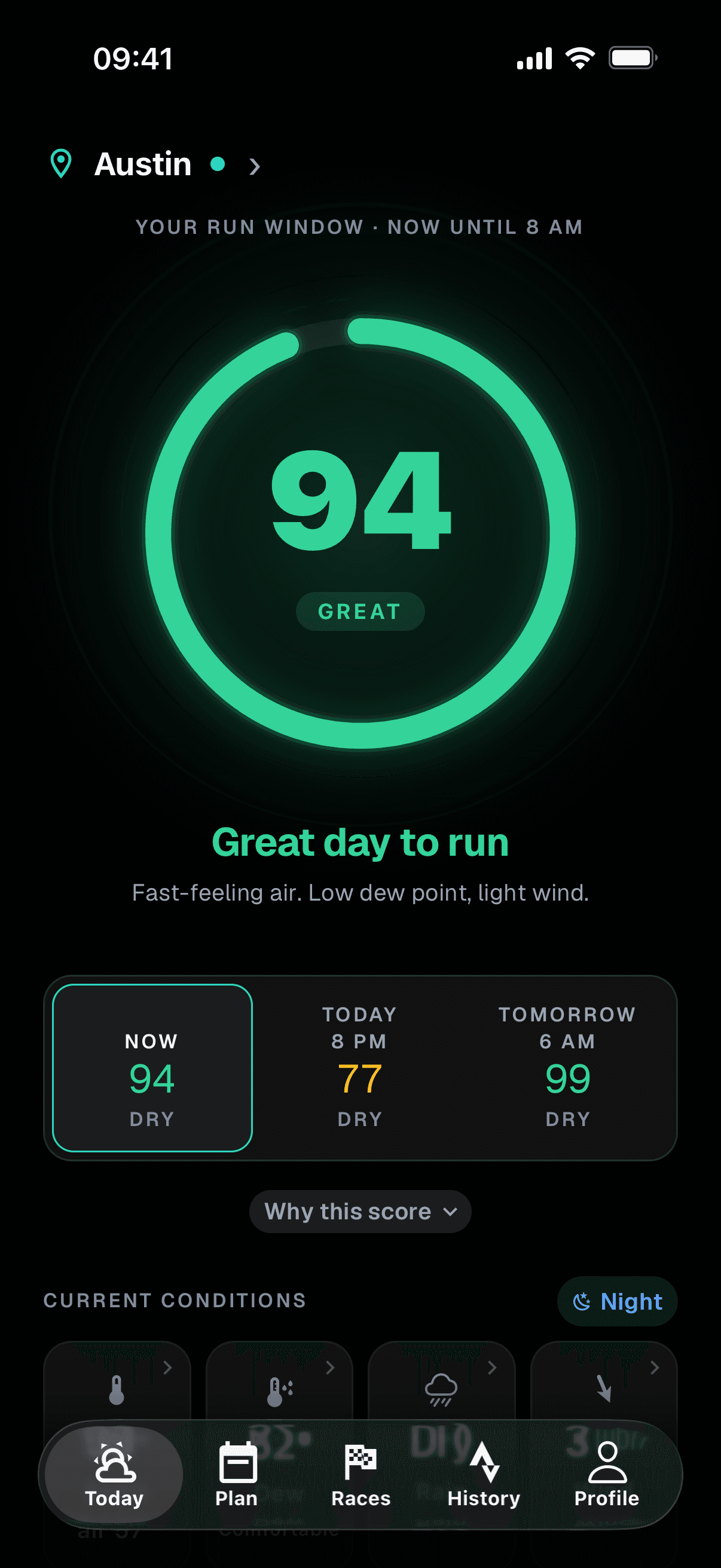

7 am · score 94
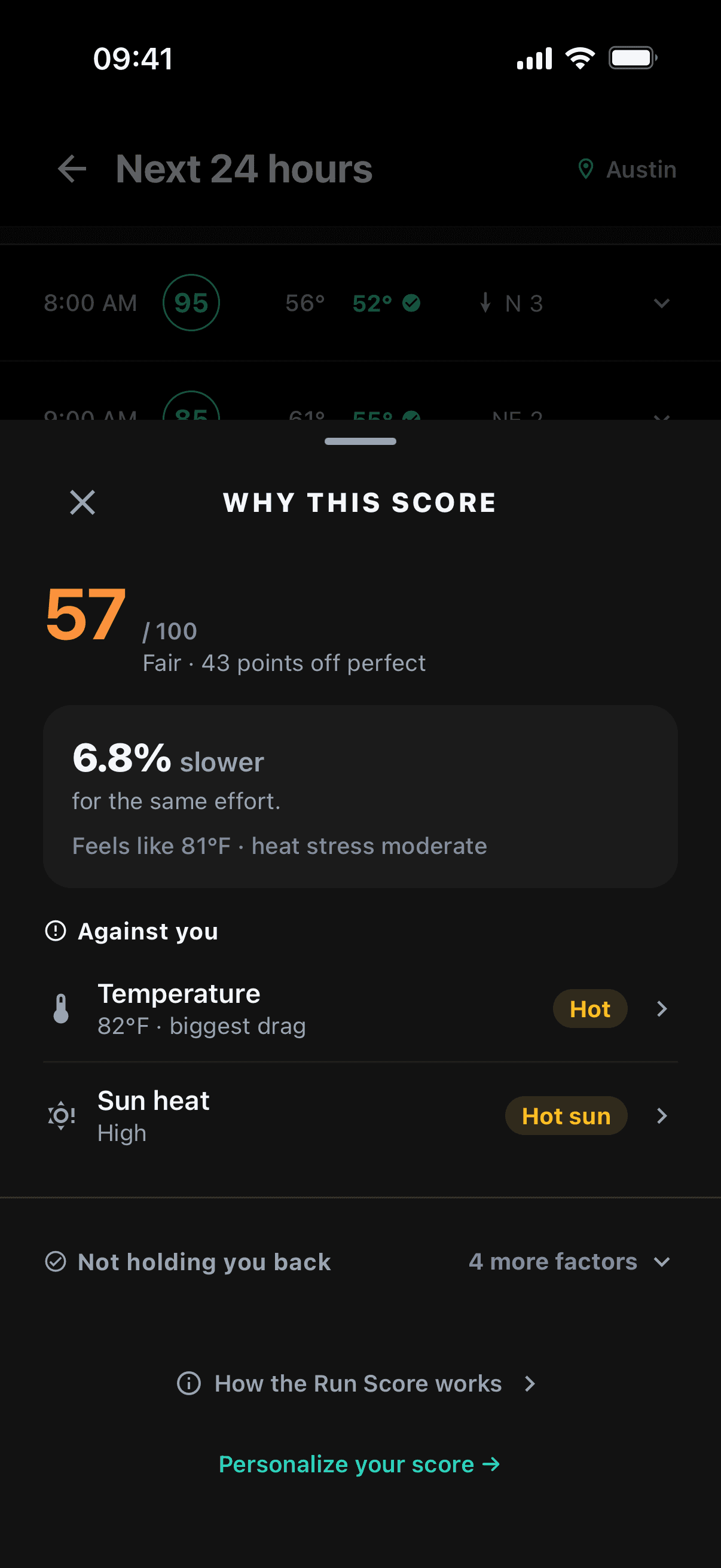
3 pm · 6.8% slower
By city
Best time to run, by city
- Best time to run in New York City
- Best time to run in Los Angeles
- Best time to run in Chicago
- Best time to run in Boston
- Best time to run in Seattle
- Best time to run in Austin
- Best time to run in Denver
- Best time to run in Miami
- Best time to run in Phoenix
- Best time to run in San Francisco
- Best time to run in Portland
- Best time to run in Washington, D.C.
- Best time to run in Atlanta
- Best time to run in Dallas
- Best time to run in Houston
- Best time to run in San Diego
- Best time to run in Minneapolis
- Best time to run in Philadelphia
- Best time to run in Nashville
- Best time to run in Salt Lake City
- Best time to run in Las Vegas
- Best time to run in Toronto
- Best time to run in Vancouver
- Best time to run in Montreal
- Best time to run in Calgary
- Best time to run in London
- Best time to run in Manchester
- Best time to run in Edinburgh
- Best time to run in Dublin
- Best time to run in Paris
- Best time to run in Berlin
- Best time to run in Amsterdam
- Best time to run in Barcelona
- Best time to run in Madrid
- Best time to run in Stockholm
- Best time to run in Lisbon
- Best time to run in Rome
- Best time to run in Munich
- Best time to run in Vienna
- Best time to run in Sydney
- Best time to run in Melbourne
- Best time to run in Brisbane
- Best time to run in Perth
- Best time to run in Auckland
- Best time to run in Wellington
- Best time to run in Singapore
- Best time to run in Tokyo
- Best time to run in Hong Kong
- Best time to run in Bangkok
- Best time to run in Seoul
More
How the score works
What the calculator scores
Eight signals, weighted by how much each changes a runTemperature. Performance peaks near 50–54°F. Every degree above that works your cooling system harder and slows the pace you can hold at the same effort.
Dew point. The real humidity signal. Above ~60°F dew point, sweat stops evaporating efficiently: the single biggest hidden driver of a hard summer run.
Wind. Sustained wind and gusts feed drag and thermal estimates. This public calculator uses a default route-exposure assumption because it does not know your running direction.
Heat stress. How hard heat, humidity, sun, and wind hit your body, combined into one number (wet-bulb globe temperature), the same metric race directors use to flag risk.
Solar exposure. Direct radiation on a shadeless route can feel far hotter than the air temperature. Cloud cover and sun angle are factored in.
Precipitation. Rain probability and intensity affect footing, comfort, and gear, weighted by how likely it is during your window.
Air quality. US AQI is folded in so sensitive runners get a clear signal when particulates make hard efforts a bad idea.
Pace adjustment. The output you actually use: how many seconds per mile to ease off today so your effort (not the clock) stays honest.
Enter your city. Search any city worldwide. RunWeather pulls the live local forecast: temperature, dew point, wind, sun, and air quality.
Get a 0–100 Run Score. One number that blends performance, safety, and experience (labeled Great, Good, Fair, Tough, or Poor) for the current hour.
Scrub the next 12 hours. Tap any hour to rebuild the full breakdown for that start time, or jump straight to the best window today.
Need a pace target for the heat instead? Try the heat and humidity pace calculator.
Running guides
Heat, humidity, wind, coldQuestions runners ask
4 questionsWhat is a good Run Score?
Scores run 0–100. 80–100 is Great (97+ earns a gold star for near-perfect conditions). 65–79 (Good) is solid. 55–64 (Fair) or 45–54 (Tough) means at least one factor (usually heat or dew point) is slowing you. Below 45 (Poor), expect a noticeably harder effort or hold back for safety.
Why does dew point matter more than temperature?
Your body cools by evaporating sweat. When the dew point climbs above roughly 60°F, the air is too saturated for sweat to evaporate efficiently, so heat builds up even if the thermometer looks reasonable. That's why a 70°F muggy morning can feel harder than a dry 80°F afternoon.
How is this different from a normal weather app?
A weather app tells you the conditions. This calculator translates them into a running decision: a single score, the best hour to head out, and a concrete pace adjustment in seconds per mile, all from the same scoring engine that powers the RunWeather app.
Is the running weather calculator free?
Yes. The calculator is completely free to use, with no account required. The RunWeather app adds Strava sync, multi-day planning, and personalized scoring on top of the same model.
From the blog
12 posts- What to Wear for a Cold Marathon Start, by Goal Time
- What to Wear Running in Cold Weather: Wind, Wetness and Waiting
- How Cold Is Too Cold to Run? The Limit Is Wind Chill on Bare Skin
- Running in the Dark: Reflectors on Your Joints Beat a Vest
- How We Price Race-Day Weather, and the Two Things We Got Wrong
- Same Temperature, Different Run: 684 City-Months of Running Weather Data
- Dew Point for Running: The Chart, and Why It Beats Humidity
- Best Time of Day to Run in Summer: Read the Dew Point, Not the Thermometer
- How Much Does Heat Affect Running Pace?
- Hydration and Sodium for Hot Runs: A Dew Point-First Plan That Avoids Overdrinking
- Treadmill vs Outdoor Running: A Weather Decision Guide
- What to Wear Running in Heat and Humidity: A Dew Point-First Gear Guide