How Much Slower Should You Run in Heat & Humidity?
How much to slow down in the heat, in real numbers: a few minutes on an easy run up to 15+ minutes on a hot marathon, plus when to run by effort not pace.

Short answer
Expect to slow a few seconds per mile on an easy run in mild heat, scaling up to 15+ minutes added on a hot, humid marathon. Once the dew point passes about 60°F (16°C), stop chasing pace targets and run by effort or heart rate instead, accepting slower splits for the same work.
For a whole summer I treated my paces as fixed and the weather as an excuse. The plan said 7:30 easy, so I ran 7:30, and when my heart rate drifted ten beats high and the last miles came apart, I filed it under bad day or lost fitness. It took too many wrecked runs to accept the obvious: a run that is genuinely easy at 50°F (10°C) becomes a threshold effort at 85°F (29°C) and high humidity, at the very same splits. The pace had not got harder. The air had.
So the worst habit in summer is the simplest, holding pace constant while the conditions move underneath you. Knowing how much to slow down, and why, is the difference between a summer that builds a base and one that leaves you flat, hurt, or sick of running.
Why pace-based thinking fails in heat
A pace target quietly assumes two things: that your sweat is evaporating and holding your core temperature down, and that your heart rate matches the work. Heat and humidity break both. When evaporation stalls, your heart rate climbs out of proportion to the pace, because your cardiovascular system is now also driving blood to the skin to shed heat, and the same speed simply takes more effort. Research backs this: heat stress impairs endurance performance and raises cardiovascular strain (Périard et al., Physiological Reviews, 2021), which is a precise way of saying your easy pace is no longer easy. What the watch calls Zone 2 can be Zone 3 or 4 in your body, and a coach who holds athletes to fixed paces through a heat wave is setting them up to fail.
What the race data shows
Marathon results are the closest thing running has to a controlled weather experiment, and the data is blunt.
A 2022 study pooled 7,867 athletes across 1,258 endurance races held between 1936 and 2019 in 42 countries. Air temperature was the single most important parameter, around 40 percent, but WBGT, which folds in humidity, predicted performance better than temperature alone (R² of 0.11 to 0.47 against 0.04 to 0.34). The optimal window was 7.5 to 15°C WBGT, roughly 10 to 17.5°C air, and every degree outside it slowed runners by about 0.3 to 0.4 percent.
John J. Davis reanalyzed the same dataset and landed in the same place: a perfect marathon temperature near 48°F (9°C), a forgiving range of 35 to 55°F (2 to 13°C), heat and humidity that compound so hot-and-humid is far worse than either alone, and truly bad conditions adding 8 percent or more, over fifteen minutes at a 3:00 marathon. One honest caveat: humidity barely bites below about 65°F (18°C), so cold and damp is tolerable.
A runner chasing 3:00 in perfect 48°F air could run the same effort on a hot, humid day and finish past 3:15. That gap is not lost fitness. It is the air.
Practical pace adjustment bands
You do not need a formula, just a few bands to run through your head before you walk out the door.
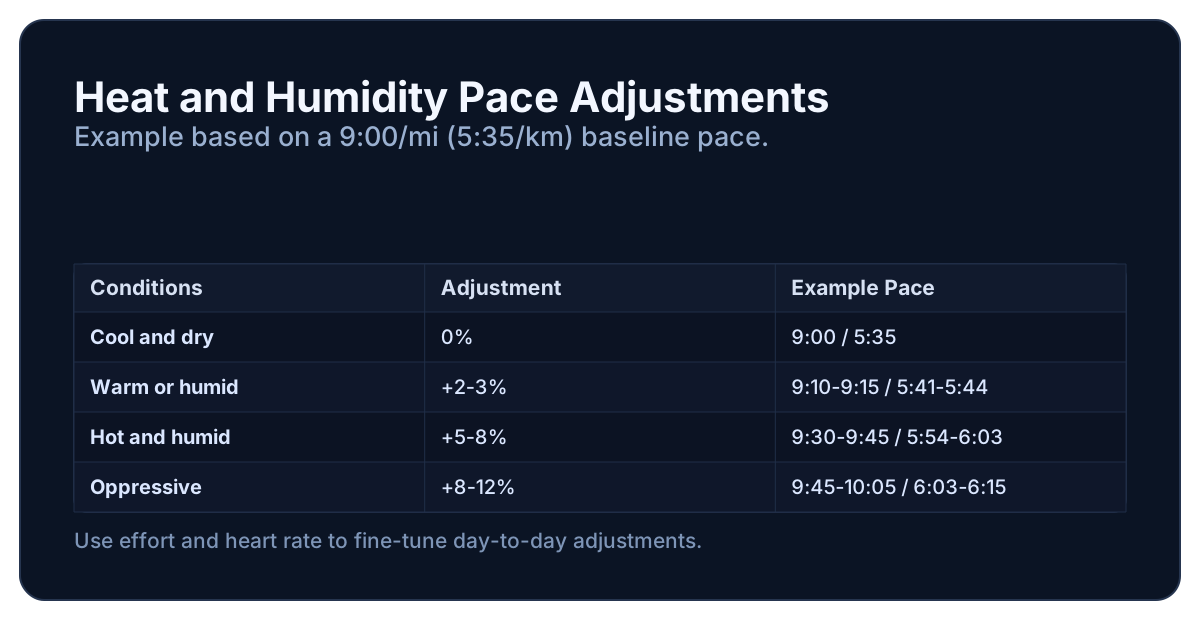
Chart sources: Mantzios et al. weather and endurance performance (MSSE, 2022), RunningWritings heat/humidity analysis, ACSM: Exercise and Fluid Replacement.
Here is the framework by dew point:
- Below 55°F (13°C) dew point: No adjustment needed. Run as planned.
- 55–60°F (13–16°C): Slow 1–3%. A 9:00/mi (5:35/km) pace becomes 9:10–9:16/mi, about 1–3 minutes over a 10-mile run.
- 60–65°F (16–18°C): Slow 3–5%, roughly 3–5 minutes over 10 miles. Same 9:00 becomes 9:16–9:27/mi. Drop structured workouts.
- 65–70°F (18–21°C): Slow 5–8%, roughly 5–8 minutes over 10 miles. Same 9:00 becomes 9:27–9:43/mi. Run by effort only.
- Above 70°F (21°C): Slow 8%+ or move indoors. Fixed pace targets are meaningless.
Percentages hide the real slowdown
A few percent sounds harmless, which is why runners shrug it off. Put it in minutes and it stops sounding harmless, and the longer and harder the effort, the more it compounds, because heat strain accumulates the whole time you are out there:
- An easy hour in warm, humid air: roughly 2 to 3 minutes slower.
- A two-hour long run in hot, humid conditions: 7 to 9 minutes slower, enough to turn the back half into a survival shuffle.
- A 3:00 goal marathon: a warm, dry day adds around 10 minutes, and a hot, humid one can add 15 to 20 minutes or more at the same effort. That is the gap between a personal best and a death march.
That 8 percent figure from the race-data analysis is why the same dew point that barely dents a 30-minute jog can wreck a marathon. Match the caution to the distance, not just the thermometer.
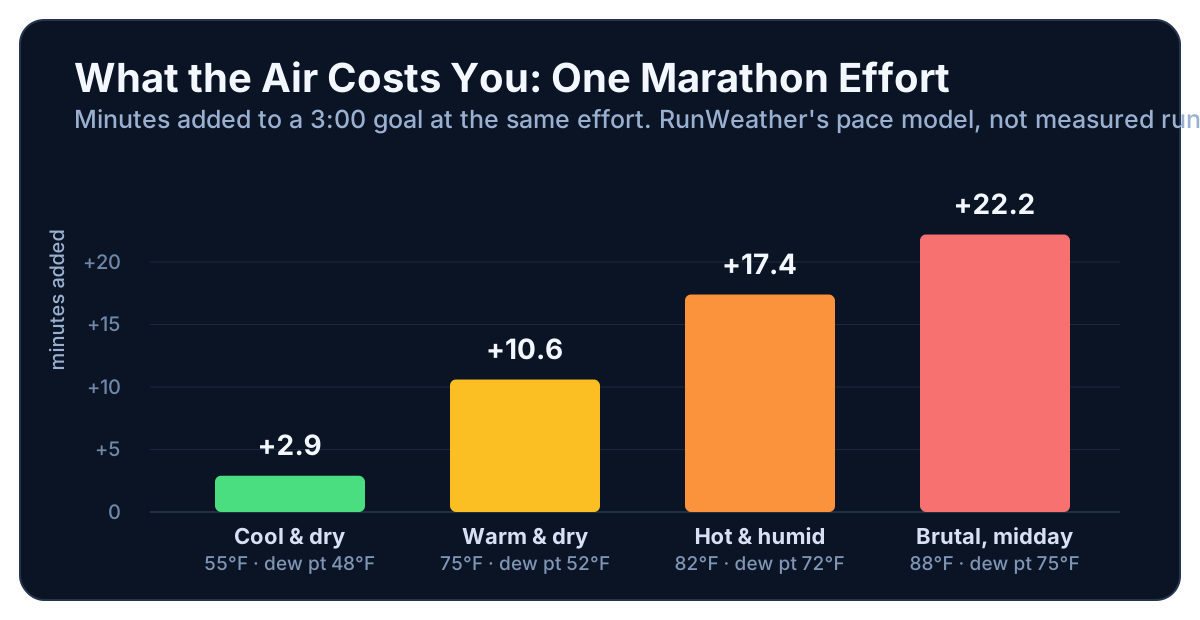
Estimates from RunWeather's own pace model at constant effort, not measured race times. Anchored to the race-data analysis finding that bad conditions add 8 percent or more.
For workouts and tempo efforts
Quality sessions are worse, because you generate more heat the harder you go. In marginal air, 55 to 65°F dew point, extend the recovery between reps by 30 to 60 seconds, cut volume rather than intensity (5×1000m instead of 6×1000m), cap your heart rate so you slow if it drifts above the target zone, and drink before and during, not only after. Above 65°F dew point, move the workout indoors. A treadmill tempo at race pace beats an outdoor tempo you cannot finish.
Why effort beats pace in summer
Good coaches moved off rigid pace targets years ago, and in summer it stops being optional. Run by effort, let the pace fall where it falls.
Heart rate is the easiest handle. Set your zones from a recent test in cool weather, keep easy runs in Zone 1 to 2 whatever the pace says, and when it drifts above Zone 2 at an easy effort, slow down or walk. A heart rate that climbs over a steady run is cardiac drift, telling you about heat, not weakness.
If you do not run on heart rate, perceived effort works. An easy run should sit around 3 to 4 out of 10; if you are breathing hard on a run meant to be easy, you are already too fast for the day. Breathing says the same thing without a number: easy pace is a comfortable conversation, a 3:3 or 4:4 rhythm, and the moment you cannot get a full sentence out, the pace needs to come down.
The mental side of slowing down
The slower splits get into your head, too. You see a GPS number that would have been a recovery jog in October and the doubts start: I am losing fitness, I should push, everyone else is faster. None of it is true. You are running the same effort, the pace is the only thing that changed, and two weeks of cooler air will prove it when your old paces come back. The runners who adjust come out with a deep aerobic base. The ones who force goal pace through every run come out hurt, fried, or both.
Warning signs you have pushed too far
Some signals are not toughness to push through, they are reasons to stop:
- Heart rate drifting more than 10 bpm above normal for the same pace
- Chills or goosebumps in the heat, which means your cooling system is overwhelmed
- Sudden loss of coordination or stumbling
- Nausea, dizziness, or confusion
- A sudden drop in sweating, which is your body giving up on cooling and a real emergency
If any of these turn up, stop, get into shade, cool down with cold water, and drink. Heat illness turns dangerous faster than most runners expect.
How I use RunWeather for this
This is the math I got tired of doing in my head and after the fact, which is why RunWeather does it for me now. It reads the dew point and temperature, tells me how much to ease off before I start, and points at the windows where a quality session will hold up. The point was never to train harder through the heat. It was to stop mistaking the weather for my fitness.
Sources & Further Reading
- Mantzios et al. Effects of Weather Parameters on Endurance Running Performance: Analysis of 1258 Races (MSSE, 2022)
- Davis JJ. Calculating the effects of heat and humidity on marathon performance (Running Writings, 2025)
- Périard JD, Eijsvogels TMH, Daanen HAM. Exercise under heat stress: thermoregulation, hydration, performance implications, and mitigation strategies (Physiological Reviews, 2021)
- American College of Sports Medicine: Exercise and Fluid Replacement Position Stand
Related reading
- The full dew point chart for runners, band by band
- Hydration and Sodium for Hot Runs
- Treadmill vs Outdoor Running: A Decision Framework
RunWeather is available now on the App Store and Google Play.