Dew Point for Running: Why It Beats Humidity
Humidity misleads runners. Dew point measures the moisture that stops sweat from cooling you, which is why it predicts a hard run, plus the bands that matter.
Short answer
Dew point, not temperature or humidity, predicts how hard a run feels. It measures the moisture already in the air, which sets how easily your sweat can evaporate and cool you. Below about 55°F (13°C) running stays comfortable; above 65°F (18°C), run by effort and expect a slower pace for the same work.
I have lost count of the runs that felt inexplicably awful at a temperature that looked completely fine on paper. Seventy-five degrees, a number I have run hard in plenty of times, and yet twenty minutes in my heart rate is climbing, my shirt is soaked through, and the pace I hold every week suddenly takes everything I have. For years I blamed myself for it. The real culprit was almost always the one number my weather app never bothered to show me: the dew point.
I built RunWeather because I got tired of reverse-engineering this after the fact, staring at a wrecked Strava file and trying to work out why an easy run had turned into a grind. Dew point is the metric I now check before every warm-weather run, and I think it is the one most runners are missing.
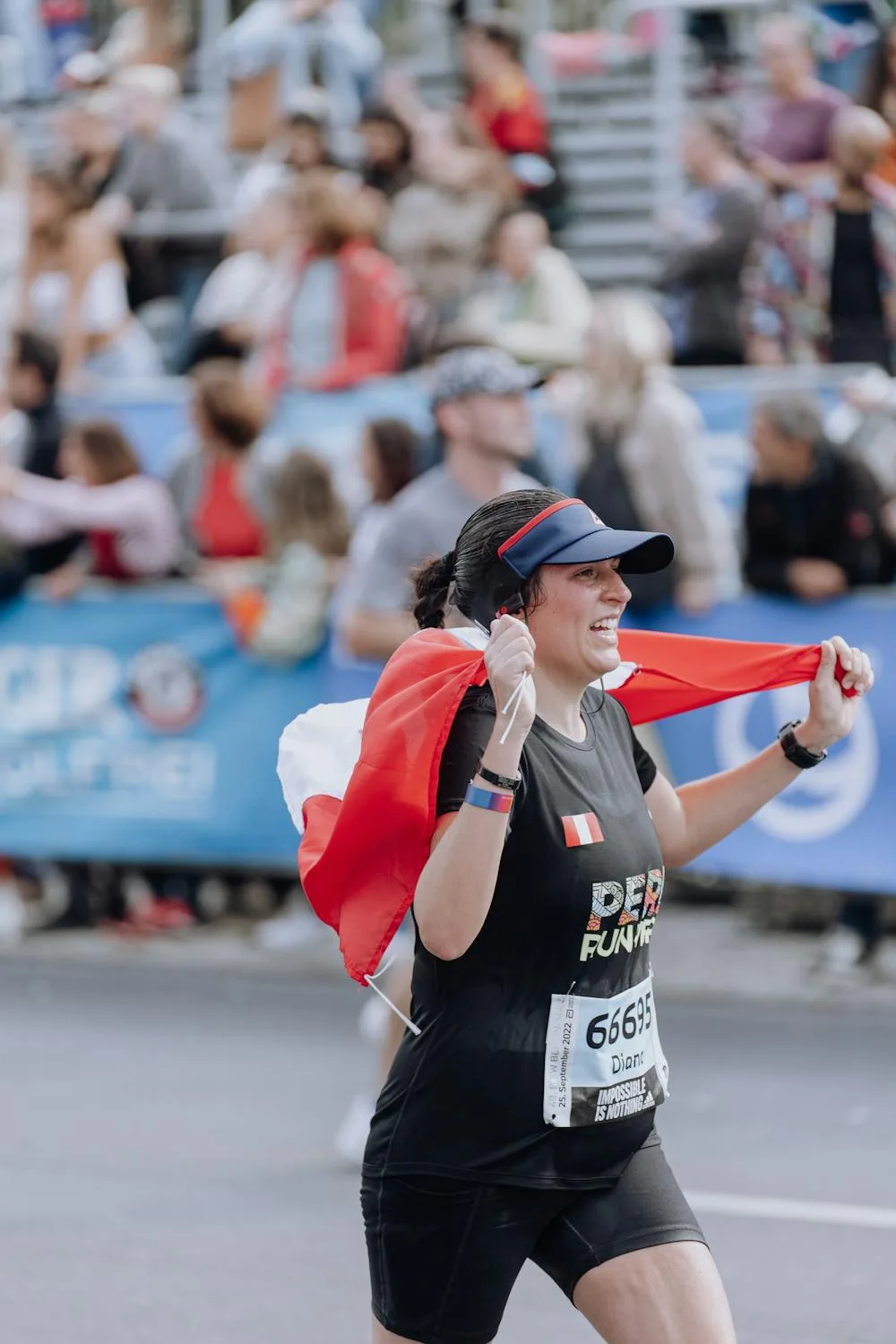
The run that made this stick for me was a good one, which is not how I expected to learn the lesson. Last November I ran a half marathon through Rome, 21.1 kilometers at 5:22 per kilometer on a cool morning that started just before ten. It was a genuinely hard effort and I finished it as a personal best. I have since run that same 5:22 pace in the middle of summer and watched it fall apart inside the first few kilometers. Same legs, same fitness, a completely different run. The variable that moved was not the number on the temperature forecast. It was how much moisture the air was holding, which is the dew point.
What dew point actually measures
Dew point is the temperature at which air becomes saturated with water vapor and moisture begins to condense. That definition is technically correct and nearly useless when you are standing in your kit deciding how fast to go, so here is the version that matters.
Dew point tells you how easily your sweat can evaporate. Evaporation is your body's primary cooling system while you run. You generate a lot of heat, your core temperature rises, and you sweat so that the sweat can evaporate off your skin and carry that heat away with it. When the air already holds a great deal of moisture, which is precisely what a high dew point means, there is less room left for your sweat to evaporate into. It sits on your skin instead of cooling it, your core temperature keeps climbing, and your heart works harder to push blood toward the skin to shed heat, which leaves less of it for your legs.
So I treat dew point as a physiological number rather than a weather one. It is a fairly direct proxy for how hard your cooling system is going to have to work today.
Why temperature alone misleads you
Two runs at the same temperature can feel like different sports. Picture two mornings, both 78°F (26°C). On the first, the dew point is 52°F (11°C), your sweat evaporates efficiently, and the run feels honest. On the second, the dew point is 70°F (21°C), the sweat sheets off you without cooling anything, and that identical pace feels like a tempo effort. The thermometer reads the same on both days. Your body does not.
This is what runners are really describing when they say dry heat is fine but humidity destroys them. They have the right instinct and the wrong vocabulary. The National Weather Service makes the same point in plainer language, advising that "if you want a real judge of just how 'dry' or 'humid' it will feel outside, look at the dew point instead of the RH." Relative humidity shifts with temperature and can read high on a cool morning that actually runs beautifully. Dew point does not have that flaw.
The short version is that humidity is relative, dew point is absolute, and the absolute number is the one that predicts your suffering.
What the race data shows
This is not just my own grumbling dressed up as a blog post. The largest analysis I am aware of pooled 1258 races held between 1936 and 2019 across 42 countries, covering 7867 athletes. Air temperature on its own turned out to be a weak predictor of performance, with R² values between 0.04 and 0.34 depending on the event. Wet bulb globe temperature, which folds humidity into the picture, did meaningfully better at 0.11 to 0.47. The authors found an optimal window of 7.5 to 15°C WBGT, roughly 10 to 17.5°C air temperature, and reported that for every degree of WBGT outside that window, performance fell by 0.3 to 0.4 percent.
Run the arithmetic on that and it gets your attention. A 10°C rise in WBGT above optimal works out to somewhere around 3 to 4 percent, which is more than six minutes added to a three-hour marathon. That is not a fitness problem. It is the air.
A separate reanalysis of marathon data by John Davis at Running Writings arrives in the same place from a different direction. He puts the perfect marathon temperature at around 48°F (9°C), with a forgiving optimal range of 35 to 55°F (2 to 13°C). Two of his findings are worth holding onto. The first is that heat and humidity are multiplicative, or in his words, "hot and humid is much worse than either heat or humidity in isolation." The second is that the slowdown at the extreme is genuinely punishing, with truly bad conditions slowing you "by upwards of eight percent, over fifteen minutes at 3:00 marathon pace."
One nuance I want to be honest about, because a lot of articles get this wrong, is that Davis found humidity barely matters until the air is above roughly 65°F (18°C). Below that, cold and damp is tolerable. And the relationship he draws is a U-shaped curve, not a cliff edge, so do not let anyone sell you a single dramatic number where everything supposedly falls apart. It is a slope, and it simply steepens as the air warms.
Where the bands sit, briefly
You do not need to memorize exact figures, you need a few bands. Comfortable running lives below roughly 55°F (13°C) dew point. Things turn noticeably sticky through the high 50s and 60s. Above about 65°F (18°C) you should be running by effort and thinking seriously about shortening or moving the session.
I keep the full chart, including thresholds broken out by race distance, in the dew point thresholds guide, so I am not repeating a giant table in every post.
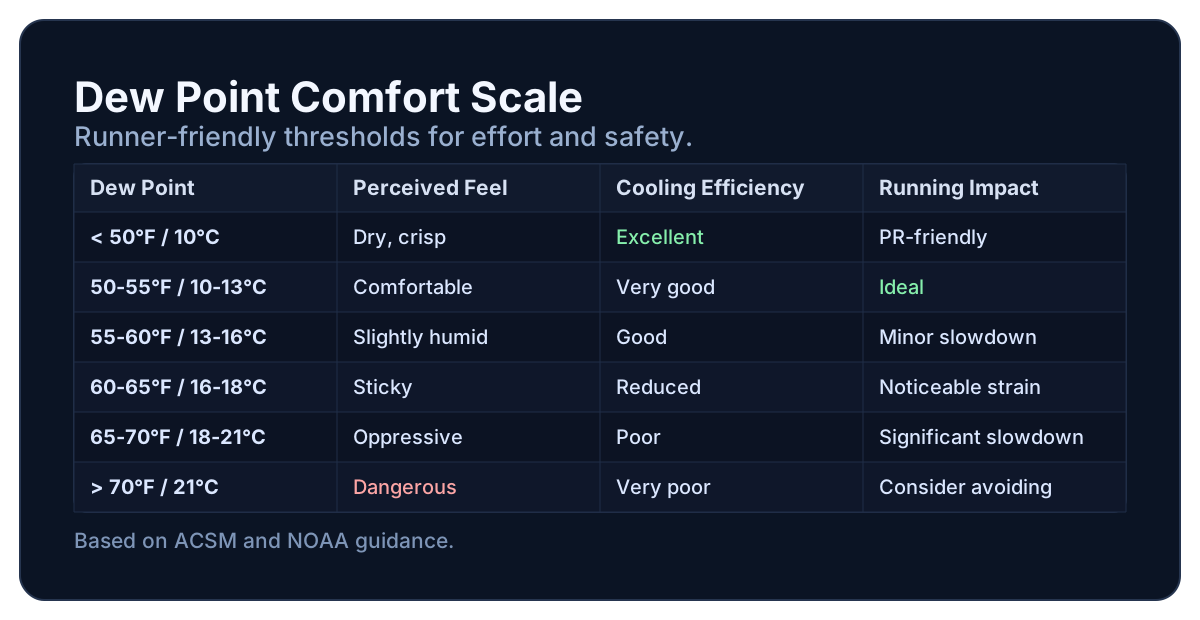
Comfort scale aligned with NWS dew point guidance and large race-performance datasets.
What is happening in your body
Once evaporation stalls, your body starts to improvise, and none of the improvisations do your pace any favors. Heart rate climbs because cardiac output has to rise to move more blood to the skin. Blood flow gets diverted toward cooling and away from the working muscles that actually need the oxygen. The net effect is that endurance performance degrades and cardiovascular strain increases, which the Périard review of exercise under heat stress documents at length.
You feel all of this as legs that will not turn over, a heart rate that looks wrong for the pace, and a growing suspicion that your easy run has quietly become a hard one. That is thermoregulation under load. It is not your fitness draining away, and reading it as fitness loss is exactly how a lot of strong runners talk themselves into overtraining through July.
Here is the part I find genuinely motivating rather than discouraging. That Rome half marathon went down as one of my hardest efforts in months, and it still produced a personal best, because the air let my body turn the effort into pace. That is the whole bargain. When the dew point is low, hard work shows up on the clock. When it is high, the same hard work gets spent on cooling instead, and you get a slower time for it. Once I started reading runs this way, I stopped treating slow summer splits as proof that I had lost fitness, and started treating them as a record of the conditions I ran in.
To put a number on that, here is what the pace model inside RunWeather does to a single marathon effort as the air turns against you. Hold the effort constant and run a 3:00 marathon on a cool, dry morning, and the conditions add under three minutes. Run that same effort on a hot, humid day and the model adds about seventeen. On a brutal midday it adds more than twenty. These are model estimates rather than measured races, and the temperature and dew point climb together the way they really do on a summer day, so read it as the shape of the thing, not a stopwatch promise. The shape is the whole argument: what the air adds is trivial when it cooperates and enormous when it does not.
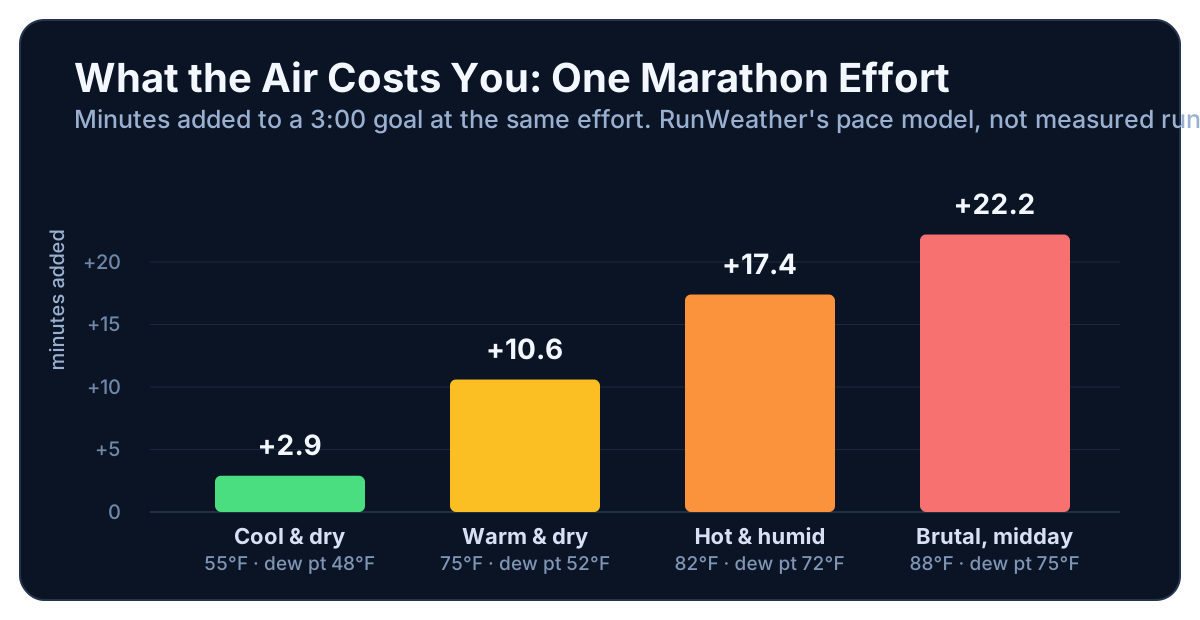
RunWeather's pace model applied to the same marathon effort across four days. Minutes are added versus running that effort in cool, dry air. Model estimates, not measured runs.
How I actually use dew point
Before a warm-weather run I ask three quick questions.
Is the dew point under 55°F (13°C)? Then I run the plan as written, quality work and race-pace efforts included. Is it between 55 and 65°F (13 to 18°C)? Then I run by effort or heart rate instead of pace, and I accept that my splits will be a little slower for the same work. Is it above 65°F (18°C)? Then I change the plan outright: move the run earlier, shorten it, slow it down considerably, or take it indoors. Nobody sets a personal best in those conditions, and pretending otherwise just buys you a miserable day and a confusing data file.
There is one trap worth flagging. Dew point does not follow temperature's tidy daily curve. In summer it is often lowest in the very early morning and then climbs through the day, sometimes even as the temperature begins to fall. So the evening run that feels like it ought to be cooler is occasionally the worse choice, because the air has spent all afternoon loading up with moisture. I dig into that timing question properly in the best time of day to run in summer.
Why RunWeather puts dew point first
Most weather apps lead with temperature and humidity, which are the two numbers least useful to a runner, and then they bury dew point a few taps deep or leave it out entirely. I understand the decision. Dew point is unfamiliar, it needs a sentence of explanation, and it does not look friendly on a clean home screen. For a general audience, that is a defensible call. For runners, it is precisely backwards.
I designed RunWeather around dew point as the main driver of effort. Rather than simply reporting conditions, it translates them into what the run will actually feel like, points you toward the best window based on how dew point moves across the day, and tells you when a day is worth adjusting your plan around. The whole reason the app exists is that I wanted to stop guessing, and stop blaming my legs for what the air was doing to them.
Sources & Further Reading
- National Weather Service (NOAA): Why Dew Point Is a Better Measure of Comfort Than Humidity
- Mantzios et al. Effects of Weather Parameters on Endurance Running Performance: Analysis of 1258 Races (MSSE, 2022)
- Davis JJ. Calculating the effects of heat and humidity on marathon performance (Running Writings, 2025)
- Périard JD, Eijsvogels TMH, Daanen HAM. Exercise under heat stress: thermoregulation, hydration, performance implications, and mitigation strategies (Physiological Reviews, 2021)
- American College of Sports Medicine (ACSM): Exercising in Hot and Cold Environments
Related reading
- The full dew point chart for runners, band by band
- How Much Slower Should You Run in Heat and Humidity?
- Best Time of Day to Run in Summer
RunWeather is available now on the App Store and Google Play.