Cold Air and Your Lungs When Running: Breathing Rate Matters Most
Cold air will not freeze your lungs, but it dries your airways, and how hard you breathe decides how much. The arithmetic, the trials, and when to see a doctor.
Short answer
Cold air does not freeze or harm healthy lungs on an ordinary run, because each breath is warmed close to body temperature before it reaches the deep lung. It does dry your airways, and how much depends mostly on how hard you breathe. Easy runs below freezing are a small dose; hard efforts, races and asthma are where caution belongs.
The first fast rep on a -10°C (14°F) morning goes fine for about a minute. Then the air starts to scrape the back of your throat, by the third rep your chest feels raw and hot at once, and that evening you are still clearing a dry cough you did not have at breakfast. It feels like the cold got into your lungs.
It did not, at least not the way it feels. Cold air does not freeze or damage healthy lungs on an ordinary run, because a breath is warmed close to body temperature before it reaches the deep lung. What cold air does is dry your airways, because winter air carries almost no water and every breath has to be humidified on the way in, and how much of that work they do depends far more on how hard you breathe than on the exact temperature. An easy run at -10°C is a small dose. Breathing near your maximum in the same air dries the airways about 2.4 times faster per minute, and if you have asthma or exercise-induced bronchoconstriction (EIB), the hard session is the one that brings on symptoms.
Your airways warm the air long before it reaches your lungs
The cleanest evidence is old and unusually direct. In 1985 McFadden and colleagues passed a thin probe of thermistors down the airways of six healthy volunteers and recorded the air temperature at six points, from the upper trachea to beyond the subsegmental bronchi, while they breathed room air and frigid air at different rates. Quiet breathing of room air read about 32°C (90°F) in the upper trachea and 35.5°C (96°F) in the small bronchi. Breathing frigid air at maximum ventilation, the hardest case they could produce, the upper trachea fell to 20.5°C (69°F) while the deepest point still read 31.6°C (89°F).
So the cold lands on the windpipe and the large airways, which is a fair match for where the burn sits when you run hard in winter, and it does not arrive in the air sacs as cold air. The frozen-lungs story is wrong. The reassurance that usually follows it is too simple, though: the authors describe "profound thermal changes that extend well into the periphery of the lung." Warming the air is the easy half of the job. Wetting it is the hard half.
Winter air is dry air, whatever the humidity reading says
Air inside your lungs is at 37°C (99°F) and saturated, about 44 grams of water vapour per cubic metre. Winter air holds a small fraction of that, and the number that tells you how small is the dew point, not the relative humidity. A frosty morning can read 85% relative humidity and still carry almost nothing, because cold air cannot hold much water even when it is full.
For the arithmetic I used the National Weather Service's vapour pressure formula, e = 6.11 × 10^(7.5 × Td / (237.3 + Td)) hPa, turned it into grams per cubic metre with the ideal gas law, and took the breathing rates measured in trained runners in a Swedish cold-air study: 68 L/min at an easy pace (about 60% of VO2max, roughly 10 km/h, or 6:00/km and 9:39/mi) and 163 L/min at their maximum.
| Dew point | Water in the air (g/m³) | Share of the water a breath needs at 37°C | Water your airways add per minute, easy run (68 L/min) | Per minute, all-out (163 L/min) |
|---|---|---|---|---|
| 65°F (18°C), a sticky summer morning | 15.7 | 34% | 2.0 g | 4.8 g |
| 50°F (10°C) | 9.4 | 20% | 2.4 g | 5.8 g |
| 32°F (0°C) | 4.9 | 10% | 2.7 g | 6.5 g |
| 14°F (-10°C) | 2.4 | 5% | 2.9 g | 6.8 g |
| 5°F (-15°C) | 1.6 | 3% | 2.9 g | 6.9 g |
| -4°F (-20°C) | 1.1 | 2% | 2.9 g | 7.0 g |
Our arithmetic, not a measurement. Water content is computed at the dew point itself. The per-minute columns are the water needed to bring each breath to 37°C and saturated, before any of it is recovered on the way out. Breathing rates from Gavrielatos et al. 2022.
The table says two things. Once the dew point is below freezing, the air is close to empty whatever it is: going from a 32°F (0°C) dew point to a -4°F (-20°C) one raises the water your airways must supply by only about 9%. The breathing rate moves the same number by 2.4 times. (Some water and heat comes back as you breathe out, so the net loss is lower than these columns. The direction is the point.)
The drying is also what turns into symptoms. The leading explanation for EIB, set out by Sandra Anderson and Evangelia Daviskas, is that as water evaporates from the thin liquid layer lining the airways, that layer turns salty and the cells beneath it release the mediators that make airway muscle contract. In their words, cold air "not only cools the airways but also increases the numbers of airway generations becoming dehydrated in the humidifying process." By our arithmetic, even at -15°C (5°F) about two thirds of the heat your airways spend on each breath goes into evaporating water, not into warming the air.
The dose is mostly how hard you breathe
So the dose has three parts: how dry the air is, how much of it you move, and for how long. The first barely changes once it is below freezing. The second changes a lot. Elite cross-country skiers sustain up to 200 L/min for long periods, according to a 2012 review of athletes' airway health by Kippelen and colleagues, which is a big part of why they are the population with the airway problems. The same review puts asthma or airway hyperresponsiveness at about 15% in Olympic Nordic combined and cross-country skiers, against under 4% in alpine skiers and ski jumpers who train in similar cold.
Duration matters less than you would guess, at least at moderate effort. Gavrielatos and colleagues had 18 healthy, endurance-trained people run at moderate intensity for 30 and for 90 minutes in a -15°C (5°F) chamber. Lung function "was not significantly affected by exercise or exercise duration", although a marker of stress in the airway lining (a protein called CC16) rose after both runs. Tripling the time did not triple anything they could measure. In a companion study from the same group, a 4-minute all-out time trial at -15°C, after a 30-minute warm-up, cut FEV1 (the air you can blow out in one second) by 2.7% on average and raised plasma CC16 by 121%.
Your nose warms and wets air far better than your mouth, but it drops out early: the Kippelen review notes that breathing switches to nose and mouth once ventilation passes about 35 L/min, well under an easy running pace. "Breathe through your nose" is advice for a walk.
What the cold-air trials found
The trials are small, done in climate chambers, and mostly in trained people, but they point the same way.
| Study | Who | Air | Session | What happened |
|---|---|---|---|---|
| Gavrielatos 2022 | 18 healthy, trained | -15°C (5°F) | 30 vs 90 min at moderate effort | No significant change in lung function; CC16 up after both |
| Stenfors 2022 | 23 healthy, trained | -15°C (5°F) | 30 min warm-up, then 4 min all-out, with and without a heat-and-moisture-exchange mask | FEV1 -2.7% without the mask, -0.5% with it; CC16 +121% vs +27% |
| Kennedy 2018 | 17 active women | 0 to -20°C (32 to -4°F), 40% humidity | Walk, 10 min run, then 8 min of heavy running, mouth uncovered | FEV1 down 4-5% from 0 to -15°C, 7% at -20°C; cough and effort up at -15°C and colder |
| Stensrud 2007 | 20 with diagnosed EIB | -18°C (0°F) vs 20°C (68°F) | Treadmill test to peak | FEV1 fall of 31% vs 24%; peak VO2 6.5% lower in the cold |
| Nisar 1992 | 7 with asthma | -13°C (9°F) | Exercise with a working or a dummy mask | Median FEV1 fall of 10% with the mask vs 22% without |
For scale, a fall in FEV1 of more than 10% after exercise is the line some guidelines use to diagnose EIB, according to the American Thoracic Society (ATS). Healthy runners in these chambers stayed well under it and recovered quickly (in Kennedy's trial, back to baseline by 20 minutes). Runners who already have EIB fell much further, from 24% in room-temperature air to 31% in the cold.
Who should be careful
EIB is common in competitive runners. Helenius and colleagues tested 58 elite Finnish runners in a sub-zero winter test and again at the end of the birch pollen season. 26% had probable EIB, 9 of the 41 tested in both seasons had it only in the winter cold-air test, and 3 only in the pollen season. An allergic tendency (atopy) predicted it, which fits the Swedish duration study, where atopic runners reported more lower-airway symptoms after the 90-minute run.
The ATS guideline adds the part that matters for self-diagnosis: EIB is established by lung function after exercise, "not on the basis of symptoms". You can have it without the classic signs and the signs without it.
The long-term question is real, but narrow. Michael Kennedy, the University of Alberta researcher behind the 2018 trial, told his university's Folio in 2020 that racing at -15 or -20°C (5 or -4°F) is "not OK" and that "if it's a really cold day in February, a high-intensity run or ski race could change your life." That caution comes from research on winter endurance athletes who breathe at very high rates in very cold air, season after season. I have not found evidence that easy recreational running in winter damages healthy lungs over time, and I would rather say that than borrow the skiers' risk for every runner. My reading is that the risk scales with breathing rate and repetition: hard sessions and races in deep cold, done often.
The cough after a cold run
Turmel and colleagues followed 53 elite winter athletes and 33 sedentary people through summer, fall and winter. Cough immediately after exercise was common in the athletes and more frequent in winter, and many also had a late cough 2 to 8 hours after training. In most of them it was not linked to bronchoconstriction, airway inflammation or a hypersensitive cough reflex.
A dry, irritable cough after a fast cold session that is gone by the next morning fits that finding, and the likeliest reading is an airway lining irritated by drying, not an injury. If the cough comes with wheeze or chest tightness, or follows most of your hard runs, that is the pattern worth getting tested.
What helps, and what each option gives up
Most of what helps does one of two things: it lowers how much air you move, or it puts some warmth and water back into each breath.
| Measure | What it does | Evidence | The catch |
|---|---|---|---|
| Run easier on the coldest days | Lowers ventilation, the biggest lever | Moderate runs at -15°C changed lung function little; all-out efforts did | The workout moves to another day |
| Warm up properly | With EIB, 10 to 15 minutes of moderately vigorous exercise can blunt it for about 2 hours | ATS: interval or combination warm-up, strong recommendation | "Does not occur in all athletes" (ATS) |
| Buff or scarf over the mouth | Keeps some exhaled warmth and moisture for the next breath | Advised by Kennedy 2018 and the AAAAI; I found no trial of buffs | Gets wet and icy on long runs |
| Heat-and-moisture-exchange mask | Raised inhaled air from -13°C (9°F) to about 19°C (66°F) | FEV1 falls roughly halved (Nisar, Stenfors); ATS: weak recommendation | 4-minute time trial 1.4% shorter, heart rate 2.7 beats higher at easy pace (Tutt 2021) |
| Hard session at the warmest hour | Less airway cooling | The afternoon is usually the warmest part of a winter day | The dew point often moves less than the temperature, so the drying barely drops |
| Hard session indoors | Warm air keeps the drying in the larger airways | Fits the Anderson and Daviskas mechanism | Heated air at 21°C (70°F) and 30% humidity has a dew point near 3°C (37°F): 12% of a breath's water instead of 5% |
A treadmill takes away the cold, not most of the dryness. Against a -10°C (14°F) dew point outside, heated winter air lowers the water your airways must add by only about 8%. It is still the better place for intervals on a brutal day, because warm air cools the airways less and you control the effort; the treadmill decision framework covers the rest of that choice.
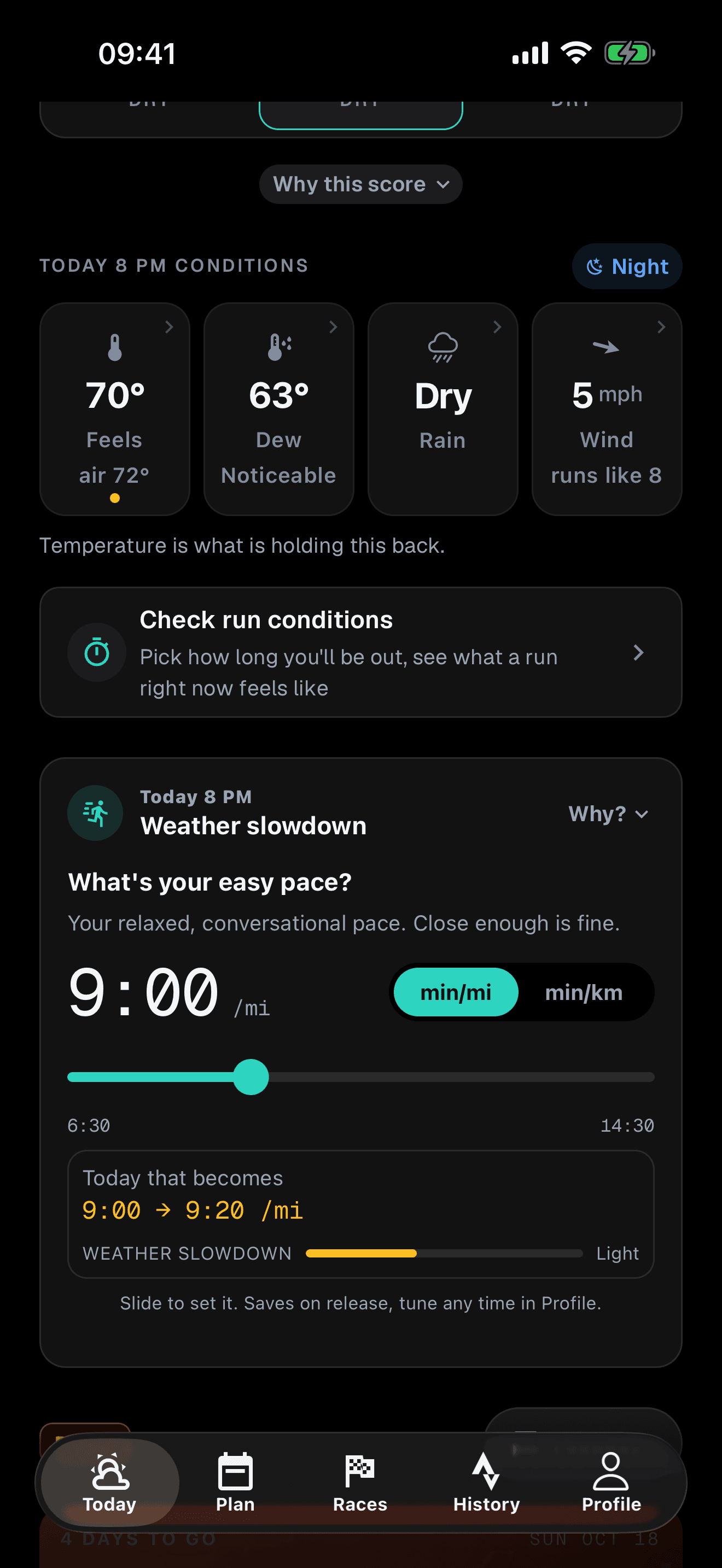
RunWeather's Run Score does not score your airways. It reads cold as an exposed-skin risk through wind chill (below -15°C, or 5°F, it reads unsafe), which is a separate problem. The free Run Score calculator shows the best hour today, and on a winter day that is often the warmest one, which is a quick way to find a slot for the hard session.
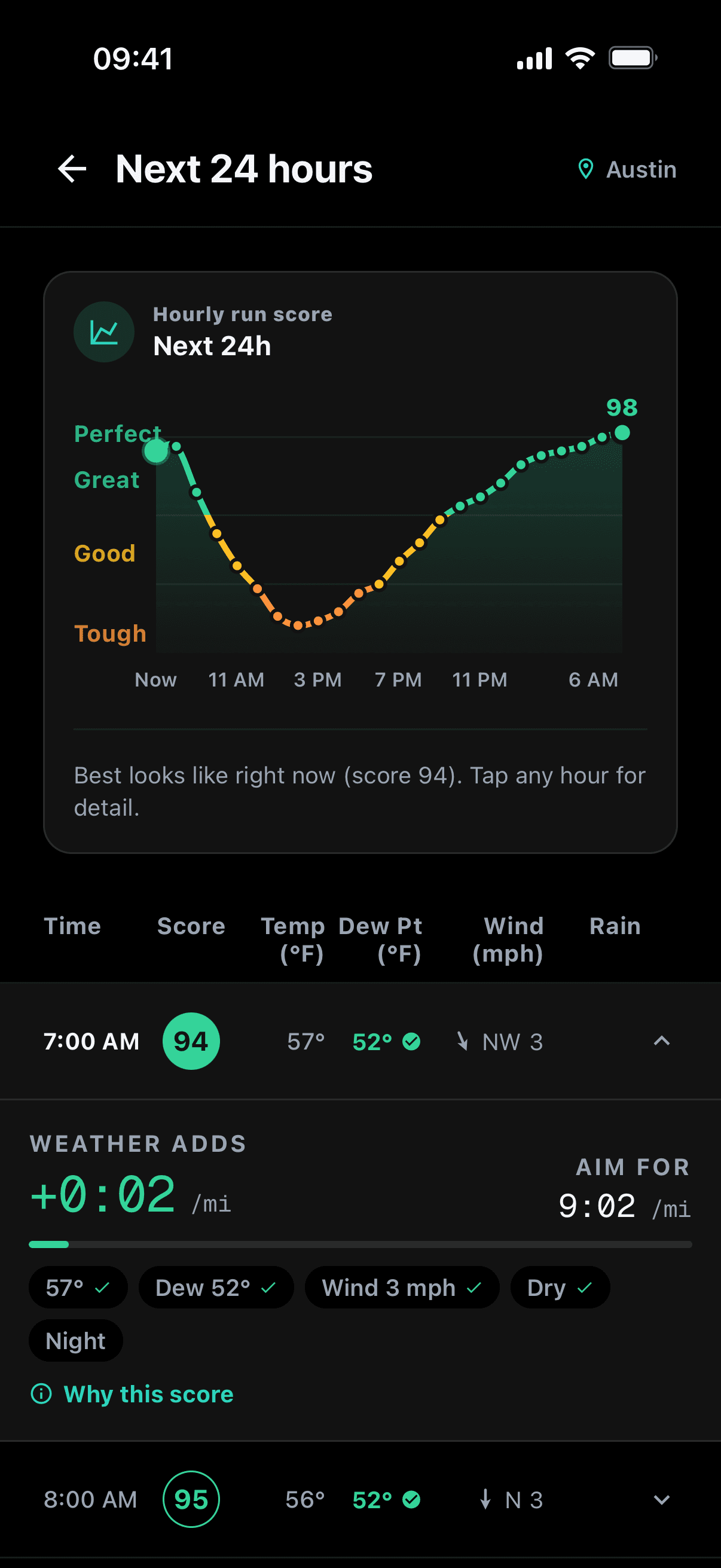

Every hour of the next day, scored, so the hard session goes in the best one.
When to see a doctor, and when to call for help
See a doctor or an allergist if you get wheeze, chest tightness, a cough or breathlessness in the 5 to 20 minutes after exercise (the window the American Academy of Allergy, Asthma and Immunology describes for EIB), if it happens after most hard runs, or if your current treatment is not controlling it. Ask about a lung function test after exercise, since that is how the diagnosis is made. If you have asthma and a reliever prescribed before exercise, cold days are when that plan matters most.
Some chest symptoms are not about the air at all. The NHS lists heart attack symptoms that include chest pain that may feel "like crushing or squeezing" and spread to the arm, neck and jaw, and sometimes a "burning feeling in your chest" like indigestion. If you have chest pain that is tight or squeezing, or spreading to your arms, neck or jaw, or you are struggling to breathe or get words out, stop running and call emergency services (911 in the US, 999 in the UK). Do not assume a burning chest in the cold is the cold.
Easy miles in deep cold are a small dose for healthy lungs. The fast miles carry most of the dose, so those are the ones to move, shorten or cover up, and if you keep wheezing or coughing after them, get it tested instead of guessing.
Frequently asked questions
Is running in cold air bad for your lungs?
Not for healthy runners on ordinary runs. Air is warmed close to body temperature before it reaches the deep lung, and chamber trials at -15°C (5°F) found small, temporary changes in lung function. Hard efforts in very cold air stress the airways more, and runners with asthma or exercise-induced bronchoconstriction feel it most.
Why do my lungs burn when I run in the cold?
Winter air holds very little water, so your airways have to warm and humidify every breath, and the windpipe and large airways do most of that work. Fast breathing during hard running cools and dries them faster. A raw throat that fades soon after the run is common. Wheeze or chest tightness is not, and needs a doctor. Chest pain that is tight, squeezing or spreading to your arms, neck or jaw is an emergency: stop and call 911 (999 in the UK).
Is it normal to cough after running in the cold?
A dry cough right after a hard cold run is common, and in a study of 53 elite winter athletes it was usually not linked to airway narrowing. If you cough or wheeze after most hard runs, or the cough lasts, ask a doctor about a lung function test for exercise-induced bronchoconstriction.
Should I wear a mask or buff when running in the cold?
Covering your mouth warms and humidifies the air you breathe. A heat-and-moisture-exchange mask cut the fall in lung function in trials at -13°C (9°F) and -15°C (5°F), though it also shortened a 4-minute time trial by 1.4%. For an easy run a buff is often enough; with asthma, follow your doctor's plan.
What temperature is too cold to run with asthma?
No single temperature is safe or unsafe for everyone with asthma. Breathing rate matters more than a few degrees: an easy run is a smaller dose than intervals in the same air. Follow your asthma plan, warm up, cover your mouth, and move hard sessions to the warmest hour or indoors on the coldest days.
Sources and further reading
- McFadden ER Jr et al. Thermal mapping of the airways in humans (J Appl Physiol, 1985)
- Anderson SD, Daviskas E. The mechanism of exercise-induced asthma is... (J Allergy Clin Immunol, 2000)
- Gavrielatos A et al. Influence of exercise duration on respiratory function and systemic immunity among healthy, endurance-trained participants exercising in sub-zero conditions (Respir Res, 2022)
- Stenfors N et al. A breathing mask attenuates acute airway responses to exercise in sub-zero environment in healthy subjects (Eur J Appl Physiol, 2022)
- Tutt AS et al. A heat and moisture-exchanging mask impairs self-paced maximal running performance in a sub-zero environment (Eur J Appl Physiol, 2021)
- Kennedy MD, Faulhaber M. Respiratory function and symptoms post cold air exercise in female high and low ventilation sport athletes (Allergy Asthma Immunol Res, 2018)
- Stensrud T, Berntsen S, Carlsen KH. Exercise capacity and exercise-induced bronchoconstriction in a cold environment (Respir Med, 2007)
- Nisar M et al. A mask to modify inspired air temperature and humidity and its effect on exercise induced asthma (Thorax, 1992)
- Helenius IJ, Tikkanen HO, Haahtela T. Occurrence of exercise induced bronchospasm in elite runners (Br J Sports Med, 1998)
- Kippelen P et al. Respiratory health of elite athletes: preventing airway injury, a critical review (Br J Sports Med, 2012)
- Turmel J, Bougault V, Boulet LP. Seasonal variations of cough reflex sensitivity in elite athletes training in cold air environment (Cough, 2012)
- Parsons JP et al. An official American Thoracic Society clinical practice guideline: exercise-induced bronchoconstriction (2013)
- American Academy of Allergy, Asthma and Immunology: Asthma and exercise
- University of Alberta Folio: Exercising in very cold weather could harm lungs over time, researcher cautions (2020)
- National Weather Service: vapour pressure formula
- NHS: Heart attack symptoms
Related reading
- Running in the cold: wind chill, layers and staying safe
- How cold is too cold to run?
- The best time of day to run in winter
RunWeather is available now on the App Store and Google Play.