Best Time of Day to Run in Winter: Early to Mid-Afternoon
January hour by hour in 21 US cities from NOAA's 1991-2020 normals: when the air is warmest, when wind chill eases, where ice and dark fall, when mornings win.
Short answer
In cold cities, early to mid-afternoon is usually the warmest, brightest and least icy part of a winter day. NOAA's 1991-2020 hourly normals put 3pm a median 11°F (6°C) warmer than 6am across 21 US airports, with a warmer wind chill at every one, even though afternoons are windier. A lunchtime run gets most of that.
The alarm goes at six on a January morning in Chicago and the window is black. The phone says 22°F (-6°C), the wind chill reads 12°F (-11°C), and the pavement outside still has last night's slush on it, frozen into ridges. If you can wait, the same day typically gives you 29°F (-2°C) and a wind chill of 19°F (-7°C) by three in the afternoon, under whatever sun there is, on a pavement that has had more than seven hours of daylight to work on it. Same city, same day, a different run.
So in cold cities the best time of day to run in winter is usually early to mid-afternoon, the warmest, brightest and least icy part of the day. Across 21 US airport stations, NOAA's 1991-2020 hourly climate normals put 3pm a median 11°F (6°C) warmer than 6am in January, and the wind chill is warmer at 3pm at every one of them, even though the afternoon is windier everywhere. The morning still wins in mild-winter cities, on days when a front brings rain, snow or wind by the afternoon, and when the afternoon is simply not an hour you can run. In summer it is the other way round, which is why the best time of day to run in summer is usually near sunrise.
A January day, hour by hour
The numbers below are NOAA NCEI's 1991-2020 hourly normals: for each date and hour, the average of up to 450 observations, that day plus or minus 7 days in each of the 30 years. They describe a typical hour, and any given morning can sit far from them. They were also measured at airports: the New York figures come from LaGuardia, not Central Park, and the wind from 10 m above open ground, so a sheltered street is usually calmer. You can check any value in the NCEI normals dataset, or open the raw API response for Chicago O'Hare on 15 January.
| City (airport) | 6am | Noon | 3pm | 6pm | Wind chill 6am | Wind chill 3pm | Sunrise | Sunset |
|---|---|---|---|---|---|---|---|---|
| Minneapolis-St Paul | 13°F (-10°C) | 19°F (-7°C) | 21°F (-6°C) | 19°F (-7°C) | 3°F (-16°C) | 10°F (-12°C) | 7:47am | 4:58pm |
| Chicago O'Hare | 22°F (-6°C) | 28°F (-2°C) | 29°F (-2°C) | 26°F (-3°C) | 12°F (-11°C) | 19°F (-7°C) | 7:17am | 4:45pm |
| Denver | 25°F (-4°C) | 40°F (4°C) | 41°F (5°C) | 32°F (0°C) | 17°F (-9°C) | 36°F (2°C) | 7:18am | 4:58pm |
| Salt Lake City | 27°F (-3°C) | 34°F (1°C) | 36°F (2°C) | 32°F (0°C) | 21°F (-6°C) | 31°F (-1°C) | 7:50am | 5:25pm |
| Boston Logan | 27°F (-3°C) | 33°F (1°C) | 35°F (1°C) | 33°F (0°C) | 18°F (-8°C) | 26°F (-3°C) | 7:11am | 4:37pm |
| Philadelphia | 31°F (-1°C) | 37°F (3°C) | 39°F (4°C) | 37°F (3°C) | 24°F (-5°C) | 33°F (0°C) | 7:21am | 5:00pm |
| New York (LaGuardia) | 32°F (0°C) | 36°F (2°C) | 38°F (3°C) | 36°F (2°C) | 23°F (-5°C) | 30°F (-1°C) | 7:18am | 4:52pm |
| Washington DC (Reagan) | 33°F (1°C) | 40°F (4°C) | 42°F (6°C) | 39°F (4°C) | 27°F (-3°C) | 37°F (3°C) | 7:25am | 5:10pm |
| Nashville | 35°F (2°C) | 43°F (6°C) | 46°F (8°C) | 42°F (6°C) | 30°F (-1°C) | 42°F (6°C) | 6:57am | 4:56pm |
| Atlanta | 39°F (4°C) | 47°F (9°C) | 51°F (11°C) | 49°F (9°C) | 34°F (1°C) | 49°F (9°C) | 7:42am | 5:52pm |
| Seattle-Tacoma | 40°F (4°C) | 44°F (7°C) | 45°F (7°C) | 43°F (6°C) | 35°F (2°C) | 42°F (5°C) | 7:52am | 4:46pm |
| Dallas-Fort Worth | 40°F (5°C) | 51°F (10°C) | 55°F (13°C) | 51°F (11°C) | 35°F (2°C) | 53°F (12°C) | 7:31am | 5:44pm |
January mean of NOAA NCEI 1991-2020 hourly normals at each airport (temperature and NCEI's wind chill normal), local clock time. Sunrise and sunset for 15 January 2027 at the station, from the NOAA solar calculator equations.
Across all 21 stations, including the nine not in the table, the 3pm normal is warmer than the 6am normal at every one, by 5 to 18°F (3 to 10°C). The coldest hour of the January day falls between 5am and 8am at every station, and most often at 7am, right in the before-work window. Noon is nearly as good as 3pm: by midday the median station has already reached about three quarters of its morning-to-afternoon warming. And the evening cools slowly, with 6pm a median 3°F (2°C) colder than 3pm, but in the dark.
December and February look the same. The 3pm normal is warmer than 6am at all 21 stations in both months, by a median 9.8°F (5.4°C) in December and 10.8°F (6.0°C) in February, and the 3pm wind chill is warmer at all 21 in both.
The afternoon is windier, and still warmer
The usual objection to the afternoon run is the wind, and the data agrees with half of it. At all 21 stations the mean January wind at 3pm is stronger than at 6am, by roughly 1 to 3 mph (1 to 5 km/h) in the cold cities in the table. Still, the wind chill normal is warmer at 3pm everywhere, by at least 6.5°F (3.6°C) and a median of 11°F (6°C). The extra afternoon wind is real, it is just not strong enough to undo the warmer air.
There is one more thing the table leaves out in the afternoon's favour. The National Weather Service's wind chill "assumes no impact from the sun, i.e., clear night sky," and adds that "bright sunshine may increase the wind chill temperature by 10°F to 18°F." A 6am wind chill in January is a night number because it is night. A 3pm wind chill on a clear day is that number before the sun is counted, which is why a bright afternoon at 25°F (-4°C) can feel like a different sport from a grey dawn at the same reading.
On the windier days, mind the order of the route. Go out into the wind and come home with it behind you, so the colder leg comes while you are dry.
Ice is mostly a morning problem
The afternoon's other advantage is underfoot. The National Weather Service describes black ice as "patchy ice on roadways or other transportation surfaces that cannot easily be seen," and says it is "most prevalent during the early morning hours, especially after snow melt on the roadways has a chance to refreeze over night when the temperature drops below freezing." It can also form "when roadways are slick from rain and temperatures drop below freezing overnight," and bridges and overpasses "freeze before other surfaces."
So the classic winter trap is a sunny, melting afternoon followed by a clear, cold night, and the morning run on the result. By the afternoon, the air has had hours above its overnight low, and in sunshine many surfaces will have softened, although shaded paths, bridges and the spots where meltwater runs across the pavement can stay frozen well after the air reads above 32°F (0°C). A forecast cannot confirm that a pavement is clear of ice, so check the route itself, and on ice run by feel with no pace target at all.
Every 6am in January is dark
On 15 January, civil dawn, the point when the sun is still 6° below the horizon and the sky starts to lighten, comes after 6:00am in all 21 cities, and a 7am start is still before sunrise in 17 of them. At the other end, a 6pm start is after civil dusk in 15 of the 21. On the shortest day, 21 December, even a 5pm start is after sunset in 14 of them.
Darkness does not change how cold the run is, but it changes two things that matter in winter: drivers see you later, and you see the ice later. If the dark morning is the run you have, it is worth doing properly, with reflective material on your ankles, knees and wrists and a light for the ground, which running in the dark goes through study by study.
Lunch, after work, and the long run
Most people do not get to run at 3pm on a Tuesday, so the useful question is which of the hours you actually have is best.
Lunch is usually the winner of the realistic options. Noon gets the median station three quarters of the way to its afternoon high, and in the cold cities it sits within a degree or two of 3pm: 19°F against 21°F in Minneapolis, 28°F against 29°F in Chicago, 36°F against 38°F at LaGuardia. It is also close to the hour when the sun is highest.
After work, from November to February, you trade light for temperature. The air at 5pm or 6pm is only a little colder than at 3pm, but in most northern cities it is dark, and around the shortest day the sun sets between 4:15pm in Boston and 4:49pm in Washington DC.
The weekend long run is where the shift makes the biggest difference. Two hours starting at 11am instead of 7am moves Chicago's typical January long run from about 22°F (-6°C) to 27°F (-3°C), and the wind chill from about 12°F (-11°C) to 17°F (-8°C). In Denver, where the dry air warms fast once the sun is up, the same move takes you from about 26°F (-3°C) to 39°F (4°C). Those are averages over 1991 to 2020 at the airport, so read them as the shape of the day, not a promise about Saturday.
To compare the hours for your own city on a given day, the free Run Score calculator puts them side by side, and the Run Score calculator page for Chicago, Minneapolis, Boston, Denver, New York or Washington DC shows how each city's months compare. In the RunWeather app, an hour whose wind chill drops below 5°F (-15°C) reads as unsafe and the exact pace target is hidden, which on the coldest mornings is often the clearest sign that waiting until after lunch is the better run.
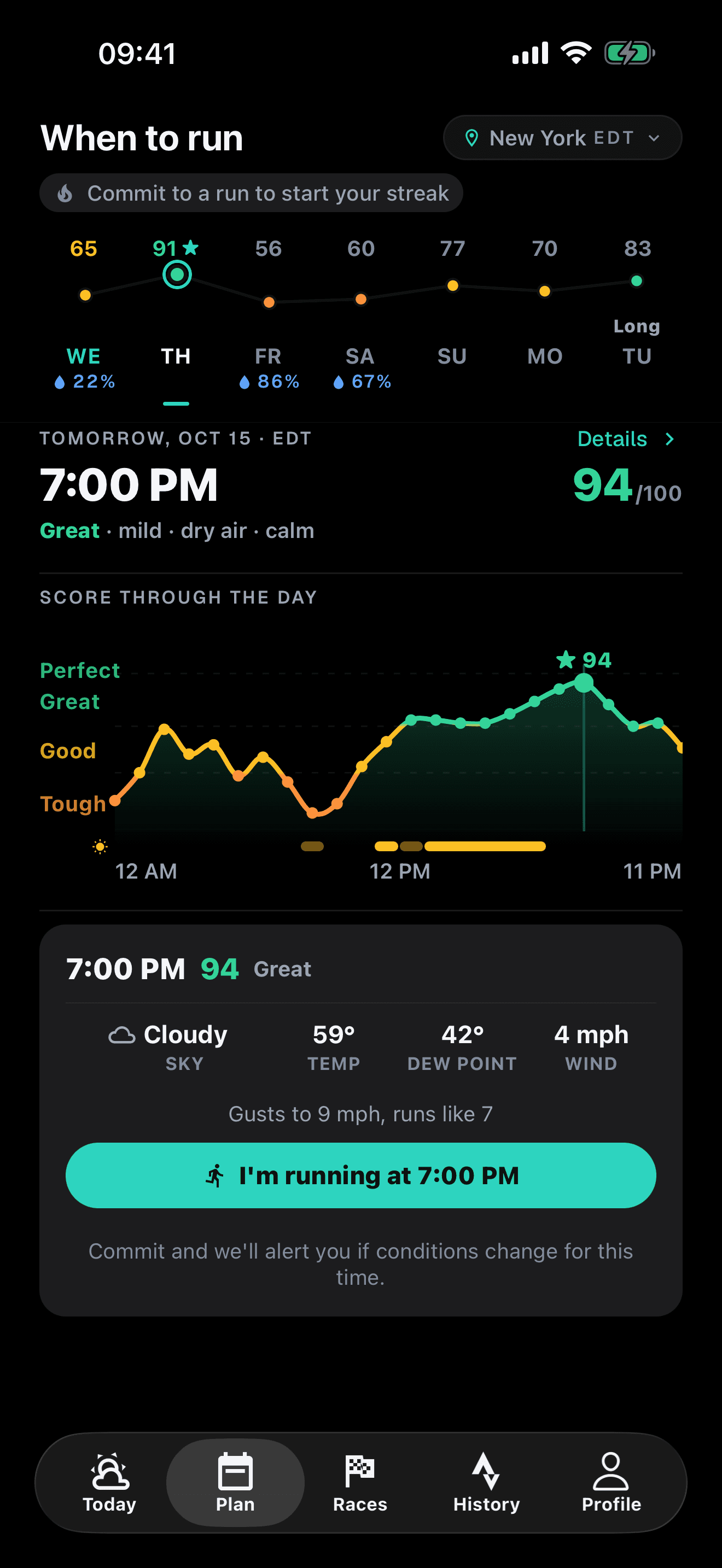

The best hour to run each day, so you can see when the afternoon wins.
Mild cities and bad-weather afternoons favour the morning
The morning is not wrong, it is just less often right in winter than in summer. It wins in a few situations.
In mild-winter cities the afternoon gets warm enough to matter. At Miami's airport the January normal runs from 64°F (18°C) at 6am to 74°F (24°C) at 3pm, at Phoenix from 48°F (9°C) to 66°F (19°C) under a sky that is overcast in only 13% of 3pm hours, and at Houston Intercontinental from 48°F (9°C) to 62°F (16°C). For a hard session there, the cool morning sits closer to the temperatures where race results are fastest.
On a given day, the weather can reverse the average. A front that brings rain, snow or strong wind by early afternoon, or freezing rain arriving at lunchtime, makes the morning the better hour, and normals cannot see that. The hourly forecast for the day can.
And sometimes the afternoon is just not yours. Then the morning run is the run, and the job is to make it a good one: dress for the coldest hour of the day, which it is, and give the first ten minutes to warming up on footing you can see.
Your body clock, for what it is worth
You may have read that you perform better later in the day. For endurance running, the evidence is thinner than that. A 2022 systematic review and meta-analysis by Knaier and colleagues at the University of Basel and Harvard Medical School pooled 29 studies and found an overall effect in favour of the evening for endurance tests, but small, an effect size of 0.23, and concluded there is "only little evidence that there is a time of peak performance in maximum endurance." The effect was clearer for short, explosive efforts: "anaerobic power and jump height are maximal between 1300 and 2000 h." For an easy winter run, the choice of hour is about the air, the light and the footing, not your circadian rhythm.
Frequently asked questions
Is it better to run in the morning or the afternoon in winter?
In most cold cities, the afternoon. Across 21 US airports, NOAA's 1991-2020 January normals put 3pm a median 11°F (6°C) warmer than 6am, the wind chill is warmer at 3pm at every station, and every 6am in mid-January is still dark. Mornings win where winters are mild, or when the afternoon is simply not an hour you can run.
What time of day is black ice most likely?
Early morning. The National Weather Service says black ice is most prevalent in the early morning hours, especially after melted snow refreezes overnight, and that it also forms when wet roads drop below freezing overnight. Bridges and overpasses freeze before other surfaces. A forecast cannot confirm that a pavement is clear of ice, so check the route itself.
Is lunchtime a good time to run in winter?
Usually, yes. By noon the median city in the NOAA data has already reached about three quarters of its morning-to-afternoon warming, and the sun is close to its highest point of the day. A 3pm start is only a degree or two warmer. On the shortest day, a 5pm start is already after sunset in 14 of the 21 cities.
Is it bad to run in the dark on winter mornings?
Not in itself, but drivers see you late and you see the ice late. Wear reflective material on your ankles, knees and wrists, which night-driving studies found drivers recognise far sooner than a vest, carry a light for the ground, and treat every shiny patch as ice until you know otherwise.
Sources and further reading
- NOAA NCEI: U.S. Climate Normals 1991-2020 and the hourly normals documentation
- NCEI Access Data Service: Chicago O'Hare hourly normals for 15 January (raw JSON)
- National Weather Service: Understanding wind chill
- National Weather Service: Ice storms, black ice and frost
- NOAA Global Monitoring Laboratory: solar calculator and its equations
- Knaier R et al. Diurnal variation in maximum endurance and maximum strength performance: a systematic review and meta-analysis (Med Sci Sports Exerc, 2022)
Related reading
- Best time of day to run in summer
- Running in the dark: reflectors on your joints beat a vest
- How cold is too cold to run? The limit is wind chill on bare skin
RunWeather is available now on the App Store and Google Play.