What to Wear for a Cold Marathon Start, by Goal Time
A cold race morning is three climates: corral, first 5K and finish. Throwaway layers, warm-up timing and race kit by goal time and start temperature.
Short answer
Dress for the race, not the corral. Wear race kit for the temperature around halfway, cover it with throwaway layers, gloves and a hat for the wait, and keep moving until the gun. Faster runners make more heat and finish sooner, so they wear less; a 5:00 marathoner makes about 57% of a 2:45 runner's heat per minute.
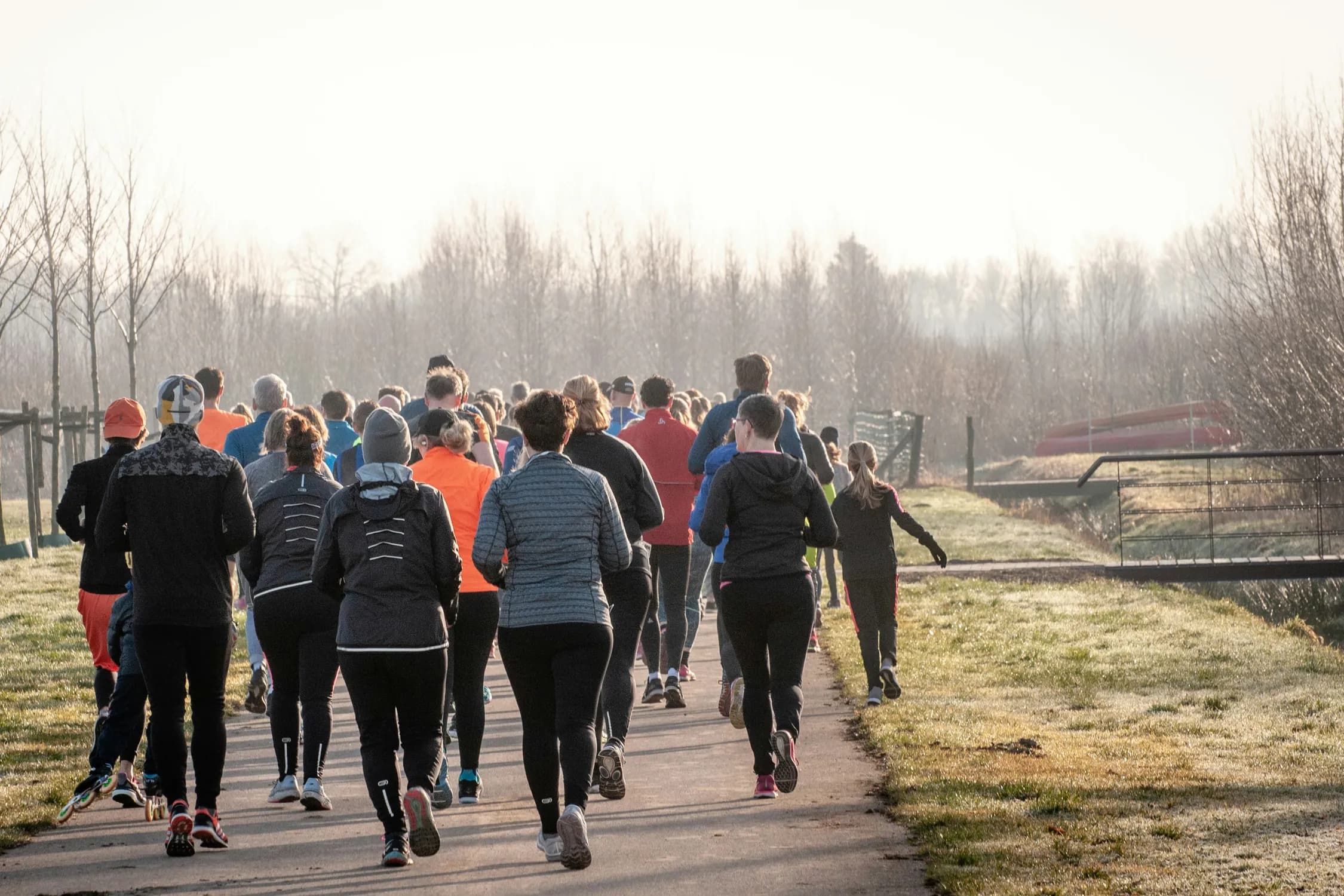
It is twenty to seven, 38°F (3°C), and you have been standing in the corral for half an hour in a charity-shop hoodie and a bin bag with holes cut for your arms. Your hands are in your armpits and your feet have gone numb. Twenty minutes after the gun the hoodie is on the kerb and you are wondering why you thought the gloves were a good idea. Three hours later, at mile 22 (35 km), the runners around you are walking through a water station in wet singlets with the wind picking up off the river, and some of them are shivering.
That is one morning, and three different climates. The answer that works for all three is to dress for the race and not for the corral: race kit chosen for the temperature you will meet around halfway, covered by throwaway layers, an old hat and gloves for the wait, with a warm-up that ends as close to the gun as you can manage. How much race kit you need depends above all on your goal time. A 2:45 runner makes about 1.7 times the heat per minute of a 5:00 runner and finishes more than two hours sooner, so the same forecast calls for two different outfits.
Three climates in one morning
The corral is the coldest part of the race. Standing still, you make about 1.3 METs (multiples of the resting rate, in the 2024 Adult Compendium of Physical Activities), and at a big-city start the wait between bag drop and the line can be long. The first 5K is the opposite problem: heat production jumps several times over within minutes, and whatever kept you warm in the corral is suddenly far too much. The finish depends on who you are. A fast runner finishes into much the same morning they started in, while a slower runner finishes hours later, often into warmer air, more wind, and legs that can no longer make as much heat.
Marathon medical data show what happens at both ends. In a review of that data, William Roberts found that finish-line medical encounters and dropouts rise as conditions move away from the most favourable range of 4.4 to 15°C (40 to 59°F) WBGT, in both directions. On cold he is specific: "Cold conditions increase the drop-out rate along the course and, if associated with wet conditions, also increase the encounter rate." Cold on its own sends more people off the course. Cold and wet also sends more of them to the medical tent.
Your goal time sets how much heat you make
| Goal time | Pace | Compendium METs | Heat compared with standing in the corral | Hours on course |
|---|---|---|---|---|
| 2:45 | 6:18/mi (3:55/km) | 14.8 | 11.4x | 2.75 |
| 3:30 | 8:01/mi (4:59/km) | 11.8 | 9.1x | 3.5 |
| 4:00 | 9:09/mi (5:41/km) | 10.5 | 8.1x | 4 |
| 4:30 | 10:18/mi (6:24/km) | 9.0 | 6.9x | 4.5 |
| 5:00 | 11:27/mi (7:07/km) | 8.5 | 6.5x | 5 |
| 5:30 | 12:35/mi (7:49/km) | 7.8 | 6.0x | 5.5 |
METs from the 2024 Adult Compendium of Physical Activities, nearest running code to each average pace (12115, 12080, 12060, 12045, 12030, 12029), divided by 1.3 METs for standing quietly (07040). Even pacing assumed. Population averages for the same body weight, not your personal physiology.
The two ends of that table are far apart. The 5:00 runner makes about 57% of the 2:45 runner's heat every minute, for 1.8 times as long. Mayhew's treadmill work found the energy cost of running stays near 0.97 kcal per kg per km whatever the speed, so both runners make about the same total heat over 26.2 miles (42.2 km); the faster one simply packs it into fewer minutes, and Batliner and colleagues found that sub-elite runners near race pace make even more than a straight line from easy pace would predict. ACSM's cold-weather consensus puts the consequence in one line: "At higher exercise workloads, less clothing is needed to protect against a fall in Tdeep," Tdeep being core temperature.
So the fast runner can race in a singlet on a morning where the slower runner wants sleeves and gloves to the finish, and both are dressing correctly.
What the morning does while you run: three winter marathons
To see how much the air changes between the gun and the finish, I pulled NOAA's 1991-2020 hourly climate normals for the airport station nearest three winter marathons.
| Race and start | Start hour: normal (10th to 90th percentile) | Around 10:00 (2:45 finish) | Around 11:00 (4:00 finish) | Around noon (5:00 finish) | Average wind, start to noon |
|---|---|---|---|---|---|
| Philadelphia Marathon, 22 Nov 2026, 7:00 | 41.5°F, 5.3°C (30.9 to 54.0°F) | 46.8°F, 8.2°C | 48.8°F, 9.3°C | 50.3°F, 10.2°C | 7.9 to 11.3 mph (12.7 to 18.2 km/h) |
| California International Marathon, 6 Dec 2026, 7:00 | 42.5°F, 5.8°C (32.0 to 53.1°F) | 49.4°F, 9.7°C | 51.8°F, 11.0°C | 53.9°F, 12.2°C | 4.5 to 7.0 mph (7.2 to 11.3 km/h) |
| Houston Marathon, 17 Jan 2027, 6:55 | 47.3°F, 8.5°C (33.1 to 64.9°F) | 53.6°F, 12.0°C | 56.3°F, 13.5°C | 58.5°F, 14.7°C | 6.2 to 10.2 mph (10.0 to 16.4 km/h) |
NOAA NCEI U.S. Climate Normals 1991-2020, hourly, at Philadelphia International (USW00013739), Sacramento Executive (USW00023232) and Houston Intercontinental (USW00012960), in local standard time, which matches the clock on these dates. Each value pools up to 450 hourly readings: the race date ±7 days across 30 years. Percentiles are of hourly readings at the start hour. Airport climatology, not a forecast and not the course. Station links open NOAA's raw data for the race date. Race dates and start times from each race's page.
Three things stand out. The typical start is cool and fine, 41 to 47°F (5 to 8.5°C), close to where marathon times are best. The spread is wide: in one hour in ten the start-hour reading at these airports is at or below about 31 to 33°F (-0.6 to 0.6°C), and in Houston one in ten is at or above 64.9°F (18.3°C). Climatology cannot choose your clothes, so pack for the range and decide from the race-week forecast.
And the finish moves with your goal time. By around 10:00 the air at these stations is typically 5 to 7°F (3 to 4°C) warmer than at the start, and by noon 9 to 11°F (5 to 6.5°C) warmer, with the average wind 40 to 65% stronger. On a normal day that warming is gentle for everyone. On a cold, wet, windy day it is the slower runner who spends the most hours in it, with the least heat to spare.
Race kit by goal time and start temperature
| Start temperature, calm and dry | Corral, everyone | 2:45 to 3:15 | 3:30 to 4:15 | 4:30 and slower |
|---|---|---|---|---|
| 50°F (10°C) | Old long-sleeved top or a bin bag | Singlet or tee, shorts | Tee, shorts | Tee or light long sleeves, shorts, light gloves |
| 40°F (4°C) | Throwaway top and trousers, old gloves and hat | Singlet or tee, shorts, light gloves, arm sleeves if you like | Tee or long sleeves, shorts or tights, gloves, headband | Long sleeves, tights or shorts, gloves, a hat you can pocket |
| 30°F (-1°C) | Throwaway fleece and trousers, hat, gloves, a bin bag over the top | Tee with arm sleeves or long sleeves, shorts or tights, gloves, headband | Long sleeves, tights, gloves, hat | Base layer plus a light top or vest, tights, gloves, hat, a packable shell |
| 20°F (-7°C) | Several throwaway layers, legs covered, mittens, hat | Long sleeves, tights, gloves, hat | Base layer plus light top, tights, mittens, hat | Base plus insulation or a shell, thermal tights, mittens, hat, neck gaiter |
Editorial starting points for a calm, dry morning, not tested rules. Add a shell, vest or poncho for rain or a steady headwind, and in rain at any temperature, dress from the next colder row. These run lighter than the easy-run bands in what to wear running in cold weather because race pace makes more heat.
The corral column is the same for everyone because everyone stands still the same way. The difference is how long you stand. Corrals at the back can wait well after the gun before reaching the start line, so slower runners usually need the throwaways for longer.
Throwaway layers, and where they go
ACSM's general advice for cold exercise is that the outer layer "should typically not be worn during exercise (unless it is raining or very windy), but should be donned during subsequent rest periods." A race start is one long rest period followed by hours of exercise, which is why throwaways exist: warm clothes you are happy never to see again. That means old fleece, tracksuit trousers you can pull off over your shoes, a bin bag with holes cut for your head and arms to keep the wind and drizzle off, cheap gloves, and an old hat.
Some large races collect what runners shed and pass it to charity. At the 2018 New York City Marathon, Goodwill NYNJ said it collected "more than 91,000 lbs. of sportswear and other textiles that runners shed at the start line," through a partnership with the city's Department of Sanitation and New York Road Runners. Arrangements vary by race and by year, so check your athlete guide for what is collected, whether bags are allowed in the start area, and where to drop layers safely, which is usually to the side and never into the path of the runners behind you.
For your hands, ACSM's frostbite advice works at a start line too: "thinner gloves worn under mitts offer dexterity for short periods." Wear mittens over thin gloves in the corral, drop the mittens at the line, and keep the gloves until your hands tell you otherwise. Chemical hand warmers, which ACSM mentions for extreme conditions, are a cheap comfort for a long wait.
Warm up late, and keep it
Most of what a warm-up does comes from heat. David Bishop's review attributes "the majority of the effects of warm up" to temperature-related mechanisms, and Racinais and Oksa put the gain for short efforts at 2 to 5% for each 1°C rise in muscle temperature. The ACSM consensus gives the other side: "For every 1 °C fall in muscle temperature there is a 4-6 % decline" in VO2max, exercise time and power.
The trouble is how quickly a warm-up fades. In Magni Mohr's study of soccer players, thigh muscle temperature rose from 36.0°C at rest to 39.4°C before kick-off, fell to 37.4°C over the 15-minute half-time, and sprint performance at the start of the second half was 2.4% lower in players who sat out the break. Players who kept moving gently through half-time kept their muscle temperature and their sprint. In a Loughborough lab, deep thigh temperature fell by about 1.3°C over 30 minutes of sitting after a warm-up, and in a related study insulated trousers did not hold muscle temperature up the way electrically heated ones did.
These are sprint and power studies, in team sports and cycling, not cold corrals. A marathon is not a sprint, and there is no reason to expect a cold corral to cool you more slowly than a lab. Put together, they say a warm-up that ends 30 or 40 minutes before a cold start is largely gone by the gun, and that the evidence favours light movement over extra clothing for keeping it. For a 5K, 10K or half marathon, finish the warm-up as late as the corral allows and keep jogging or skipping on the spot. For a marathon, a short warm-up is plenty, and the first mile at an easy rhythm can do the rest.
Rain, wind and the slow finish
Rain changes every row of that kit table. In Ryo Ito's chamber study, seven men running 30 minutes at 5°C (41°F) under 40 mm of rain per hour, a downpour, had lower core and skin temperatures and higher oxygen use than when dry. The CDC is clear that someone chilled by rain or sweat can become hypothermic at temperatures above 40°F (4°C); the running in the cold guide explains why wind chill, not air temperature, is the number to watch. And ACSM explains who it reaches first: in cold air the risk peaks once someone is injured or exhausted and can no longer keep exercising. That describes the last hour of a 5:00 marathon on a wet day precisely, the runner walking more, making less heat, soaked, with the wind up. If the race-week forecast shows rain and temperatures in the 40s°F (5 to 10°C), that runner should start with more than the table says, keep a poncho or bin bag on longer, and carry a light shell and a cap.
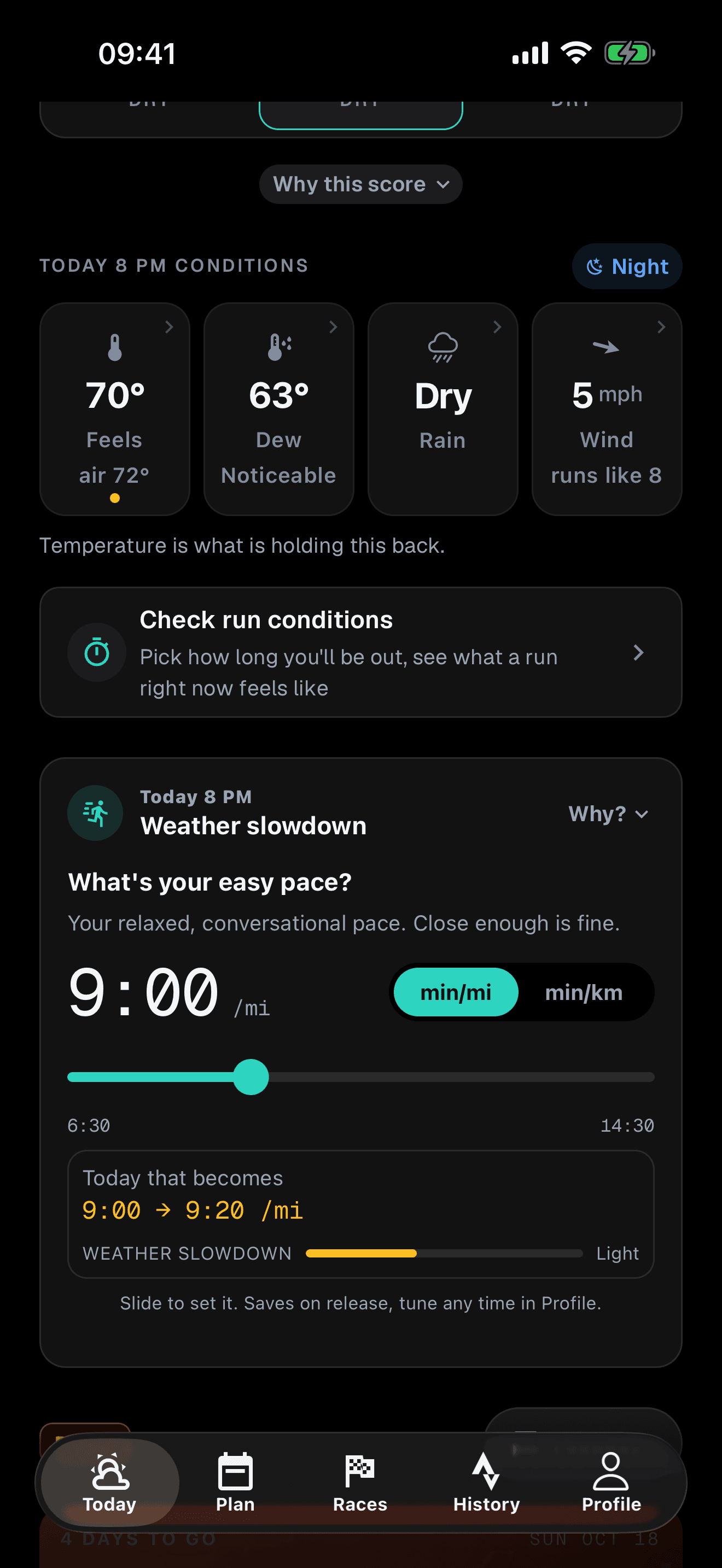
RunWeather's race plans read the hours you will be on course for your goal time, and they warn about rain rather than adding time for it, so treat a rain warning on a cold race as a clothing decision first.
The finish is a second wait, in wetter clothes. Take the foil blanket, keep walking, and get into the dry clothes from your bag before you queue for anything. The NATA position statement on cold injuries puts it simply: "Remove wet clothing as soon as practical and replace with dry, clean items."
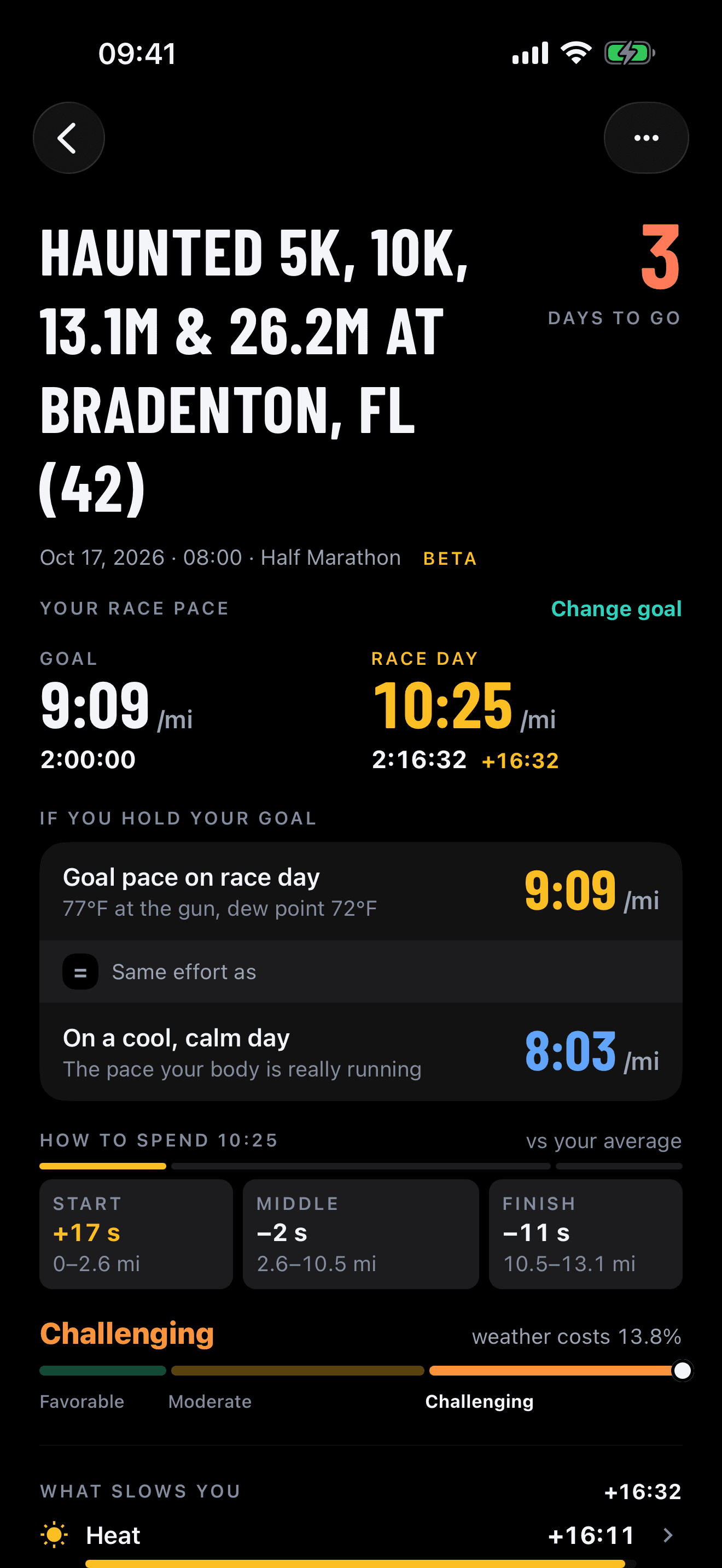

The race plan reads the hours you will be on course for your goal time. Example race: a hot half marathon in Florida.
The same advice, by race
The table above uses three US races because NOAA publishes hourly normals for their airports. The logic transfers to any winter or early spring marathon, such as Valencia in December or Tokyo in March, and the race pages on this site show hour-by-hour weather for each race's calendar window in 2021 to 2025.
The aim is to stand on the line slightly cold, take the first mile easy, and finish the race you trained for, rather than one decided by the hour you spent in a corral.
Frequently asked questions
What should I wear at a marathon start when it is cold?
Wear your race kit underneath, chosen for the temperature around halfway, and cover it with throwaway layers, an old hat and gloves for the wait. Keep moving in the corral, shed the outer layers in the first mile or two, and keep a hat and gloves you can pocket if the morning stays cold.
What are throwaway clothes at a marathon?
Old or second-hand clothes you wear in the start area and drop at the start line or in the first miles. Large races often collect them for charity: at the 2018 New York City Marathon, Goodwill NYNJ collected more than 91,000 pounds of clothing shed at the start. Check your race's athlete guide for what it allows.
Should I wear gloves in a cold marathon?
Below about 45°F (7°C), light gloves are worth having, because fingers cool long before the rest of you. Cheap gloves you can drop or tuck into a waistband are the simplest choice. Slower runners, and anyone facing rain or wind, should plan to keep them on to the finish.
How long before a race should I warm up in the cold?
As close to the start as the corral allows. In lab and field studies, muscle temperature fell within 15 to 30 minutes of stopping, and light movement kept it up. For a 5K or 10K, finish the warm-up late and keep moving; for a marathon, the first mile can do most of the job.
What should I wear for a marathon in cold rain?
Race kit that dries fast, a cap with a brim, gloves, and a bin bag or light poncho for the start that you can keep on longer than usual. Plan for the second half, when you are slower and wetter: hypothermia can happen above 40°F (4°C) in wet clothes, and slower runners are out the longest.
Sources and further reading
- NOAA NCEI: U.S. Climate Normals 1991-2020, hourly (station files and documentation); raw data for the race dates: Philadelphia, 22 Nov, Sacramento, 6 Dec, Houston, 17 Jan
- Roberts WO. Heat and cold: what does the environment do to marathon injury? (Sports Med, 2007)
- Castellani JW et al. ACSM Expert Consensus Statement: Injury Prevention and Exercise Performance during Cold-Weather Exercise (Curr Sports Med Rep, 2021), full text: University of Portsmouth repository
- 2024 Adult Compendium of Physical Activities (MET values)
- Mayhew JL. Oxygen cost and energy expenditure of running in trained runners (Br J Sports Med, 1977)
- Batliner ME et al. Does metabolic rate increase linearly with running speed in all distance runners? (Sports Med Int Open, 2018)
- Bishop D. Warm up I: potential mechanisms and the effects of passive warm up on exercise performance (Sports Med, 2003)
- Racinais S, Oksa J. Temperature and neuromuscular function (Scand J Med Sci Sports, 2010)
- Mohr M et al. Muscle temperature and sprint performance during soccer matches: beneficial effect of re-warm-up at half-time (Scand J Med Sci Sports, 2004)
- Raccuglia M et al. Post-warm-up muscle temperature maintenance: blood flow contribution and external heating optimisation (Eur J Appl Physiol, 2016)
- Faulkner SH et al. Reducing muscle temperature drop after warm-up improves sprint cycling performance (Med Sci Sports Exerc, 2013)
- Ito R et al. Effects of rain on energy metabolism while running in a cold environment (Int J Sports Med, 2013)
- CDC: Preventing hypothermia
- Cappaert TA et al. NATA Position Statement: Environmental Cold Injuries (J Athl Train, 2008)
- Goodwill NYNJ: 2018 TCS New York City Marathon clothing collection
Related reading
- What to wear running in cold weather: wind, wetness and waiting
- How the race plan reads race-day weather
- Race weather guides
RunWeather is available now on the App Store and Google Play.