Running in the Dark: Reflectors on Your Joints Beat a Vest
What night-driving studies found about being seen, how the clock change moves your usual run into darkness city by city, and what to wear running in the dark.
Short answer
Most US pedestrian deaths happen in the dark, and drivers recognise a runner much sooner when reflective material sits on the parts that move: ankles, knees and wrists. A vest or bright colours alone do far less under headlights. Add a light, choose routes away from fast traffic, and assume the driver has not seen you.
On Monday 2 November you lace up at half past five for the same loop you ran on Friday, and the street is a different place. On Friday the sun was still up. Tonight, in New York, it set at 4:51pm, the cars have their headlights on, and you are wearing the same dark tights and the black jacket that looked perfectly sensible last week. Nothing about your run has changed. What a driver can see of you has.
The thing that protects you most in the dark is being recognised as a person early, and the research on that is unusually clear: reflective material on the parts of you that move, your ankles, knees and wrists, lets drivers recognise you far sooner than a reflective vest or bright colours do. Add a light so you can see the ground, choose routes away from fast traffic, and run as if the driver has not seen you, because pedestrians overestimate how visible they are. According to NHTSA, 77% of the people on foot killed on US roads in 2023 died in the dark.
The clock change moves your run into darkness overnight
The US clocks go back on Sunday 1 November 2026. Europe, the UK and Ireland go back a week earlier, on Sunday 25 October. For an evening runner, that one hour turns a daylight run into a dark one with no transition at all, while the morning runner gets some light back for a few weeks before the shortening days take it again.
The sun times below are for eleven of the 21 US cities in our winter dataset, computed at each city centre from the NOAA solar calculator equations, and a sample checked against the US Naval Observatory matched to the minute.
| City | Sunset 31 Oct | Sunset 2 Nov | Sunset 21 Dec | A 5:30pm start on 2 Nov | Sunrise 2 Nov | Sunrise 21 Dec |
|---|---|---|---|---|---|---|
| Boston | 5:39pm | 4:36pm | 4:15pm | Dark | 6:19am | 7:10am |
| Seattle | 5:53pm | 4:50pm | 4:20pm | Dark | 6:55am | 7:55am |
| Chicago | 5:46pm | 4:43pm | 4:23pm | Dark | 6:24am | 7:15am |
| New York | 5:53pm | 4:51pm | 4:32pm | Dark | 6:28am | 7:17am |
| Minneapolis | 6:02pm | 5:00pm | 4:34pm | Dark | 6:53am | 7:48am |
| Denver | 5:59pm | 4:57pm | 4:39pm | Dark | 6:30am | 7:18am |
| Los Angeles | 6:01pm | 4:59pm | 4:48pm | Dark | 6:14am | 6:55am |
| Washington DC | 6:09pm | 5:06pm | 4:49pm | Twilight | 6:37am | 7:23am |
| Dallas | 6:37pm | 5:35pm | 5:25pm | Daylight | 6:46am | 7:26am |
| Atlanta | 6:46pm | 5:44pm | 5:33pm | Daylight | 6:58am | 7:38am |
| Miami | 6:40pm | 5:38pm | 5:35pm | Daylight | 6:30am | 7:03am |
Local clock time at the city centre, from the NOAA solar calculator equations, checked against the US Naval Observatory. "Dark" means after civil dusk, when the sun is more than 6° below the horizon; "twilight" means between sunset and civil dusk.
Across all 21 cities, a 5:30pm start is in daylight everywhere on Saturday 31 October. On Monday 2 November it starts after sunset in 15 of them, and after civil dusk, which is properly dark, in 12. By 21 December it is after sunset in 18. The morning swings the other way: a 6:30am start is before civil dawn in 20 of 21 cities on 31 October, in only 2 on 2 November, and back to 17 by the shortest day. In Europe the jump is the same shape a week earlier. In London a 5:30pm start is in daylight on Saturday 24 October and in the dark on Monday the 26th, with sunset at 4:45pm, and by 21 December the sun sets at 3:53pm.
The clock change is also how researchers have separated the effect of light from everything else that changes at night. When John Sullivan and Michael Flannagan used the daylight saving transitions that way, across US fatal crashes from 1987 to 1997, the crashes involving pedestrians were the most sensitive to light level, "in some cases showing up to seven times more risk at night over daytime." An earlier analysis by Susan Ferguson and colleagues estimated that keeping daylight saving time all year would have meant 727 fewer fatal crashes involving pedestrians from 1987 to 1991, because it moves an hour of light into the busy evening.
How many pedestrians die in the dark
NHTSA's latest pedestrian fact sheet counts 7,314 people on foot killed in US traffic crashes in 2023, and its definition of a pedestrian explicitly includes anyone "running, jogging" or walking. Of those deaths, 77% happened in the dark, against 19% in daylight and 2% each at dusk and dawn. In the winter months, January, February and December, 34% of them happened between 6pm and 8:59pm, which is the after-work run window precisely. In the autumn months the same three hours held 32%.
I want to be honest about what those numbers are. They count everyone on foot, not runners, and NHTSA reports alcohol involvement, for the driver or the pedestrian or both, in 46% of fatal pedestrian crashes in 2023. A sober runner in reflective gear on a quiet path is not the average case in that table. But the daylight saving studies above point the same way, and they were designed to separate the light from everything else that changes at night. It is the dark.
What drivers can see at night
The best evidence comes from researchers at Queensland University of Technology and Clemson University, who spent years putting pedestrians on dark roads and measuring when drivers first recognised them. The main studies, in their own numbers:
| Study | Set-up | What was compared | Result |
|---|---|---|---|
| Wood, Tyrrell and Carberry, 2005 | 10 younger and 10 older drivers on a closed road at night | Four clothing set-ups, low and high beams, with and without glare | Recognised only 5% of pedestrians in black clothing on low beams with glare, and 100% of pedestrians with reflective strips on the joints when there was no glare. Without glare, mean recognition distance ran from 0 m (older drivers, low beams, black clothing) to 220 m, 722 feet (younger drivers, high beams, reflective joints) |
| Balk and colleagues, 2008 | 120 people driven along an open road at night | Black clothing alone, or with 302 cm² of reflective material in four layouts | Longest distances with the full biological-motion layout on the joints, and still "surprisingly long" with only ankles and wrists. A reflective vest did no better than no reflective material at all |
| Wood and colleagues, 2017 | 14 young drivers on a closed road, eye tracking | A reflective vest alone, or the vest plus joint markers | Recognised the pedestrian at 319.1 m (1,047 ft) with joint markers against 184.5 m (605 ft) with the vest alone, and could tell which way the pedestrian faced at 215.4 m against 95.6 m |
| Wood and colleagues, 2012 | 12 younger and 12 older drivers, a cyclist pedalling in place | Black, a vest, or a vest plus ankle and knee reflectors; bike light off, steady or flashing | The vest plus ankle and knee reflectors was recognised at significantly longer distances than the vest alone or black clothing. The bike light, steady or flashing, did not make the cyclist more conspicuous |
| Tyrrell, Wood and Carberry, 2004 | 20 pedestrians on a closed road | Pedestrians pressed a button when they thought an approaching driver could first recognise them | They "overestimated their visibility and dramatically underestimated the benefit of conspicuity treatments" such as reflective clothing |
Figures as reported in each paper's abstract; feet are my conversions.
The 2017 distances matter more once you turn them into time. A car at 40 mph (64 km/h) covers about 17.9 metres every second, so 184.5 m is roughly ten seconds of warning and 319.1 m is roughly eighteen. Black clothing on low beams with glare, the condition in which drivers recognised 5% of pedestrians, gives most drivers no warning at all. And these drivers knew they were in a study about pedestrians and were watching for one, which an ordinary driver on the way home is not. A 2014 study by the same group found that older drivers recognised pedestrians at about half the distance of younger ones.
Why your ankles beat your chest
The reason is perceptual, not optical. A vest is a bright rectangle, and on a dark road a bright rectangle could be a sign, a bin or a parked car. Reflectors on the ankles, knees and wrists move the way only a human body moves, and the visual system picks out that pattern, which researchers call biological motion, quickly. In the 2017 eye-tracking study, drivers' eyes first landed on the pedestrian after 1.1 seconds on average with joint markers, against 3.5 seconds with the vest alone. The 2016 review by Richard Tyrrell, Joanne Wood and colleagues sets the goal: a pedestrian at night should be more than "simply visible (detectable as an ambiguous object)", they should "attract the attention of drivers and be readily perceivable as pedestrians." Markers on the extremities do that; "retroreflective markings on the torso (for example, vests) are less effective."
Colour does far less after dark. NHTSA's own advice to people on foot is to "wear bright clothing during the day and wear reflective materials or use a flashlight at night," and that is the right split. Bright and fluorescent colours stand out against a daylit street, while at night what a driver notices is whatever sends their own headlights back at them, which is precisely what reflective material is made to do.
What to wear running in the dark
None of this needs special kit, which is the encouraging part.
- A reflective band on each ankle, the cheapest and most effective thing on this list, because the feet move the most. Many running tights and shoes carry reflective detail low on the leg already; check that a long sock or a jacket is not covering it.
- Bands on the wrists, and reflective detail at the knees, to finish the pattern.
- A light at the front, mainly for you. A head torch or chest light shows you the kerb, the pothole and, in winter, the frozen puddle. Drivers will see it too, but the cyclist study is a warning not to rely on a light alone to tell them that what they see is a person.
- A red light at the back, steady or flashing, for the cars coming up behind you.
- The vest, if you own one, with the bands rather than instead of them. In the 2017 study the vest with joint markers did far better than the vest alone.
Then the habits. Use sidewalks and paths where they exist; where there is no sidewalk, NHTSA advises keeping to the shoulder facing traffic and not letting a phone or headphones take your eyes and ears off the road. I would rather run a quiet street with slow cars than a fast main road with good streetlights, cross where drivers expect people, and make eye contact before stepping out. The dark also hides your footing, so in winter the same route can hold ice you will not see until you are on it, which is one more job for the light pointed at the ground. Fog makes all of this worse at once, because the NWS tells drivers in fog to keep to low beams, the condition in which dark clothing did worst in the 2005 study.
When you get to choose the hour
If your day allows it, the simplest fix is to move the run into the light, and in most cold US cities the warmest, brightest part of a winter day is early afternoon. For many people the dark run is the only run, which is fine. It just has to be planned like one.
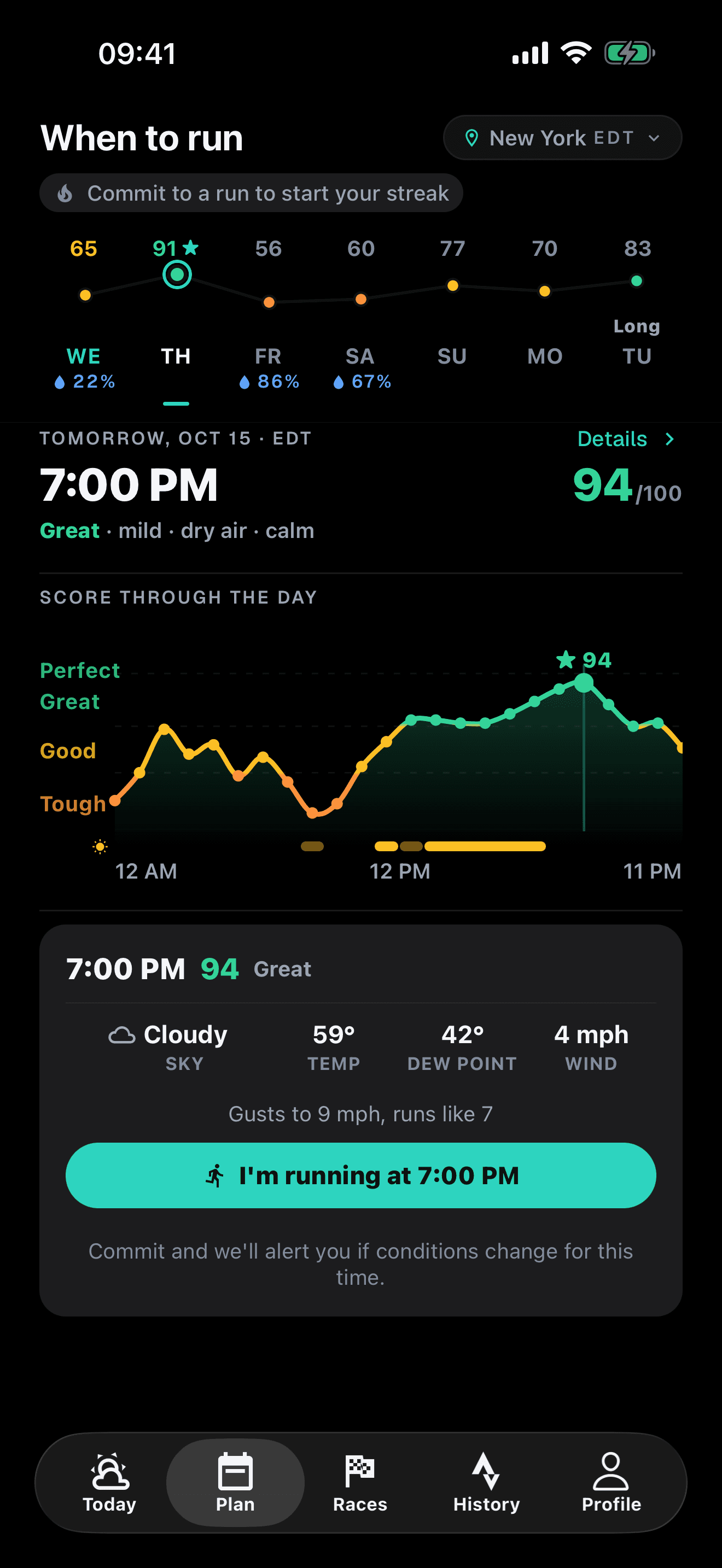
In RunWeather, darkness does not lower the Run Score, because it does not change what your pace should be, and the risk it carries is one that lights, reflectors and the route do most to reduce. Instead, a dark hour gets a tip, "Dark outside: wear reflective gear, stay visible". What no forecast can tell you is how well a street is lit or how fast its traffic moves. That part is yours.
So put the bands on your ankles before you reach for the jacket, and run the dark miles as if every driver is looking somewhere else, because on any given night some of them will be.
The best hour to run each day of the week.
Frequently asked questions
Is it safe to run in the dark?
It can be, but the risk is real: 77% of the 7,314 pedestrians killed on US roads in 2023 died in the dark, according to NHTSA. Make yourself recognisable as a person, with reflective material on your ankles, knees and wrists and a light, choose paths away from fast traffic, and never assume a driver has seen you.
What should I wear running in the dark?
Reflective material on the parts that move, ankles first, then knees and wrists, plus a front light for the ground and a rear red light. In closed-road studies drivers recognised pedestrians with reflectors on their joints much farther away than pedestrians in a reflective vest. Bright or fluorescent colours help in daylight, not under headlights.
Is a reflective vest enough for running at night?
On its own, no. In an open-road study of 120 people, a pedestrian in a reflective vest was recognised no sooner than one with no reflective material at all, and in a closed-road study adding joint markers to a vest raised the recognition distance from 184.5 m to 319.1 m (605 to 1,047 feet). Keep the vest if you like it, and add bands on your ankles and wrists.
Should I run with or against traffic at night?
Use a sidewalk or a path when there is one. Where there is none, NHTSA's advice for people on foot is to keep to the shoulder facing traffic, so you see the cars coming, and to stay alert rather than lost in your headphones.
When do the clocks change in 2026?
In the EU, the UK and Ireland the clocks go back on Sunday 25 October 2026. In the US they go back on Sunday 1 November 2026. A 5:30pm run that starts in daylight in all 21 US cities we checked on 31 October starts after sunset in 15 of them on 2 November.
Sources and further reading
- NHTSA. Pedestrians: 2023 data, Traffic Safety Facts DOT HS 813 727 (June 2025)
- Wood JM, Tyrrell RA, Carberry TP. Limitations in drivers' ability to recognize pedestrians at night (Human Factors, 2005)
- Balk SA, Tyrrell RA, Brooks JO, Carpenter TL. Highlighting human form and motion information enhances the conspicuity of pedestrians at night (Perception, 2008)
- Wood JM, Tyrrell RA, Lacherez P, Black AA. Night-time pedestrian conspicuity: effects of clothing on drivers' eye movements (Ophthalmic Physiol Opt, 2017)
- Wood JM et al. Using reflective clothing to enhance the conspicuity of bicyclists at night (Accid Anal Prev, 2012)
- Wood JM, Lacherez P, Tyrrell RA. Seeing pedestrians at night: effect of driver age and visual abilities (Ophthalmic Physiol Opt, 2014)
- Tyrrell RA, Wood JM, Carberry TP. On-road measures of pedestrians' estimates of their own nighttime conspicuity (J Safety Res, 2004)
- Tyrrell RA et al. The conspicuity of pedestrians at night: a review (Clin Exp Optom, 2016)
- Sullivan JM, Flannagan MJ. The role of ambient light level in fatal crashes: inferences from daylight saving time transitions (Accid Anal Prev, 2002)
- Ferguson SA et al. Daylight saving time and motor vehicle crashes (Am J Public Health, 1995)
- NOAA Global Monitoring Laboratory: solar calculator and its equations
- US Naval Observatory: sun and moon data API
Related reading
- Running in the cold: wind chill, layers and staying safe
- What to wear running: the guide for every temperature
- Treadmill vs outdoor running: a weather decision guide
RunWeather is available now on the App Store and Google Play.