What to Wear Running in Cold Weather: Wind, Wetness and Waiting
Cold-run clothing from 50°F down to below 0°F (10 to -18°C), plus the changes for wind, rain, sun, pace and standing still that most charts leave out.

Short answer
Pick a starting outfit from the air temperature, then adjust it for wind, wetness, sun and your pace, which makes 6 to 11 times the heat of standing still. Dress to feel slightly cold in the first few minutes, plan a layer for every stop, and change out of wet clothes as soon as you finish.
You open the door at seven in the morning, the phone says 34°F (1°C), and the air on your face says it is a lot colder than that, so you go back for the jacket. Ten minutes later you are sweating into it on the sheltered side of the park, you unzip, and then the route turns along the river into the wind and the base layer, now soaked through, goes cold against your back for the last 2 miles (3 km) home. The temperature barely moved in that hour. The wind did, the wetness did, and your body went from standing still to making about eight times the heat.
So start from the air temperature to choose a drawer, then adjust for the four things the thermometer cannot see, which are wind, wetness, sun and the heat your own pace makes, and plan a separate layer for every minute you will spend standing still. The bands below are starting points, because nobody has tested an exact temperature-to-outfit table and the "dress 15 to 20 degrees warmer" rule has no study behind it that I could find. The American College of Sports Medicine's 2021 cold-weather consensus, written about group settings but true of everyone, says people "should adjust clothing to their own physiological responses (e.g., sweating) and not wear a standard amount of clothing."
The what to wear running guide has one chart for every season. This post covers the cold half only, and the adjustments that decide whether a cold run feels honest or miserable.
Cold running clothes by temperature, from 50°F to below 0°F
Read each row as a calm, dry, easy run of 30 to 60 minutes. Wind, wet, sun and pace move you up or down a row.
| Air temperature | Top | Legs | Hands, head and face |
|---|---|---|---|
| 41 to 50°F (5 to 10°C) | Long-sleeved top, or a tee if you run warm | Tights or running trousers, shorts by preference | Light gloves you can stuff in a pocket |
| 32 to 41°F (0 to 5°C) | Long-sleeved base layer, a vest or light shell on exposed routes | Tights or running trousers | Light gloves, headband or thin hat |
| 23 to 32°F (-5 to 0°C) | Base layer plus a light second layer or wind shell | Tights, thermal tights if slow or windy | Gloves, hat over the ears |
| 14 to 23°F (-10 to -5°C) | Base layer, light insulation, wind shell | Thermal tights or two layers | Mittens, or gloves under mittens, hat, neck gaiter |
| 0 to 14°F (-18 to -10°C) | Base, insulation, windproof shell with a high collar | Thermal tights with a windproof front, or tights under wind pants | Mittens over liners, gaiter or balaclava over nose and cheeks |
| Below 0°F (-18°C) | Check the wind chill before anything else | Full wind protection | No exposed skin, see the frostbite section below |
Editorial starting points, not tested clothing or safety cutoffs. The 0°C, 5°C and 10°C edges are the cold and cool labels the RunWeather engine and the clothing guide already use; the rows below freezing are my own finer split.
In every row, the layer against your skin should be one that, in ACSM's words, "does not readily absorb moisture," which rules out cotton.
Wind chill describes your face, not your jacket
The wind chill number on your phone was built for one patch of skin. Maurice Bluestein and Randall Osczevski, who designed the current North American chart, wrote that "to avoid consideration of clothed individuals, areas of exposed skin were concentrated on. In winter, the area most exposed is the face." Their model assumes an adult walking into the wind at 1.34 m/s (3 mph), with face-level wind at two-thirds of the wind measured at 10 m, and the National Weather Service defines it only at or below 50°F (10°C) with wind above 3 mph (5 km/h). It is a frostbite number for bare cheeks. It says nothing about how warm your jacket will feel.
What wind does to a clothed body is a separate problem, and ACSM is blunt about it: wind "markedly increases convective heat loss, decreases clothing insulation capacity, and increases evaporative heat loss." You dress for the middle clause. Wind pushes through fleece and loose knits and carries off the warm air they hold, so on a windy day a thin windproof shell over your usual base layer often does more than a thicker layer the wind blows straight through.
Running also makes its own wind. At a 10:00 mile (6:13/km) you move through 6 mph (9.7 km/h) of air on a still morning, twice the walking speed the chart assumes. On an out-and-back, start into the wind, so the sweaty second half comes home with the wind behind you; the running in wind guide covers routes and gusts.
Wet cold: rain, drizzle and your own sweat
A wet 37°F (3°C) morning is usually harder to dress for than a dry 23°F (-5°C) one. In a 2013 chamber study, Ryo Ito and colleagues had seven men run 30 minutes at 70% of VO2max at 5°C (41°F), once dry and once under 40 mm of rain per hour, a downpour. In the rain, core and skin temperatures were significantly lower, and oxygen use, ventilation and blood lactate were higher. Winter drizzle is far lighter than that, so read it as the direction of the effect, not its size. The CDC makes the safety version of the point: someone chilled by rain, sweat or cold water can become hypothermic at temperatures above 40°F (4°C).
Sweat does the same thing from the inside. ACSM notes that sweating "can easily exceed the vapor transfer rate of the outer shell layer, causing moisture to accumulate on the inside, even if the outer layer has substantial venting," and that the outer layer "should typically not be worn during exercise (unless it is raining or very windy)." So the shell is a tool for rain and wind, not a default, and you should plan on being somewhat wet whatever you buy. The forecast fields for rain are in the running in the rain guide.
Your pace decides how warm you dress
Pace is the reason one chart cannot fit everybody. The 2024 Adult Compendium of Physical Activities lists the energy cost of activities in METs (multiples of the resting rate), and on flat ground at a steady pace almost all of that energy ends up as heat in your body.
| What you are doing | Pace | Compendium METs | Heat compared with standing still |
|---|---|---|---|
| Standing still (start line, traffic light, waiting for a friend) | none | 1.3 | 1x |
| Walk break or recovery walk, level, 2.8 to 3.4 mph (4.5 to 5.5 km/h) | 17:39 to 21:26/mi (10:58 to 13:19/km) | 3.8 | 2.9x |
| Easy jog, 5.0 to 5.2 mph | 12:00/mi (7:27/km) | 8.5 | 6.5x |
| Steady run, 6 to 6.3 mph | 10:00/mi (6:13/km) | 9.3 | 7.2x |
| Steady run, 6.7 mph | 9:00/mi (5:36/km) | 10.5 | 8.1x |
| Brisk run, 7.5 mph | 8:00/mi (4:58/km) | 11.8 | 9.1x |
| Tempo, 8.6 mph | 7:00/mi (4:21/km) | 12.5 | 9.6x |
| Fast, 10 mph | 6:00/mi (3:44/km) | 14.8 | 11.4x |
MET values from the 2024 Adult Compendium of Physical Activities (codes 07040, 17190, 12030, 12050, 12060, 12080, 12100, 12120). The last column is my division by the 1.3 METs for standing quietly. Population averages for the same body weight, not your personal physiology.
Two things stand out in that table. The first is the gap between standing and running, a factor of six to eleven, which is why an outfit that feels right on the doorstep is too warm a mile later, because you choose it at 1.3 METs and wear it at 9 or 10. ACSM calls this "a common problem," people who "begin exercising while still wearing clothing layers appropriate for resting conditions, and thus are 'overdressed' after initiating exercise."
The second is the gap between runners. A 12:00 mile makes about two-thirds of the heat per minute of a 7:00 mile, so the slower runner, the run-walker and anyone keeping a friend company should dress about one row warmer. Mayhew's treadmill study found the energy cost of running stayed near 0.97 kcal per kg per km whatever the speed, so a faster runner makes about the same heat per kilometre and packs it into fewer minutes (Batliner and colleagues later found sub-elites near race pace make even more). Long runs often end slower, wetter and more tired, and ACSM puts the greatest hypothermia risk in cold air at the point where an injured or exhausted runner can no longer keep exercising.
Waiting is the coldest part of a cold run
Every stop drops you back to the top row of that table. The traffic light, the group waiting for the last runner and the photo at halfway put you at about one-seventh of your running heat, in clothes you chose for running and that are now damp. ACSM's advice is to put the outer layer back on "during subsequent rest periods," and the National Athletic Trainers' Association adds the part people skip: "Remove wet clothing as soon as practical and replace with dry, clean items." Keep a dry top and hat by the door or in the car, and change before the coffee, not after. A race morning in a corral is the extreme case, which is what the throwaway layer in the table below is for, and the race guides show the weather at the start on past race mornings.
Moving up or down a row: the adjustment table
| Condition on the day | What it does | Change from your row |
|---|---|---|
| Breeze of about 10 to 15 mph (16 to 24 km/h) on an exposed route | Pushes warm air out of fleece and knits | Add a windproof shell or vest, cover the ears, start into the wind |
| Wind of 20 mph (32 km/h) or more | Wind chill on bare skin falls fast, fingers first | Dress one row colder, mittens, face cover once below freezing |
| Drizzle or rain at 33 to 45°F (1 to 7°C) | Wet skin and clothing lose heat much faster | Shell, cap with a brim, fast-drying base, shorter loops, dry clothes ready |
| Wet snow or sleet near 32°F (0°C) | Wet clothing plus uncertain footing | As for rain, plus spare gloves; check the footing on the route itself |
| Bright sun and light wind | Sun adds heat you feel within minutes | One row lighter, or a zip and sleeves you can open |
| Overcast, or a run that ends after sunset | No sun, and the air is usually cooling | Stay on your row, or one row warmer for long runs |
| Intervals or tempo | More heat while running, cold recoveries | Lighter for the reps, a layer for warm-up and recoveries |
| Long run of 90 minutes or more | Slower, wetter and more tired late on | Packable shell, a route past home or the car |
| Run-walk, easy shuffle, slow group | Less heat per minute (see the pace table) | One row warmer |
| Group start, race corral, photo stops | Standing still, about 1.3 METs | A throwaway or extra layer you can leave behind |
Editorial adjustments, not tested rules. "One row" refers to the temperature table above.
Hands, ears and face freeze first
The extremities set the limit long before your core does. ACSM notes that "exposed fingers will freeze at a warmer WCT than the cheek," WCT being the wind chill temperature, and that "wet skin cools more rapidly and may increase risk." Its glove advice: "thinner gloves worn under mitts offer dexterity for short periods when the hands are removed from those thicker mitts."
For bare skin the official numbers are fairly clear. The NWS chart puts 0°F (-18°C) with a 15 mph (24 km/h) wind at a wind chill of -19°F (-28°C), where "exposed skin can freeze in 30 minutes." ACSM puts the risk of frostbite on bare skin at "less than 5 %" with the air above -15°C (5°F), and calls for "increased safety surveillance" once the wind chill falls below -27°C (-17°F), "when frostbite can occur in 30 min or less." The NATA statement, written for athletic trainers, asks for "additional protective clothing" and covering "as much exposed skin as practical" at a wind chill of 25°F (-3.9°C) and below, and to "consider terminating or rescheduling activity" at 0°F (-17.8°C) and below. Each is a line drawn for its own audience, none is a pace number, and whether to go at all is the subject of how cold is too cold to run. If skin comes home hard, frozen, swollen and numb, or blisters, the NHS says to get emergency care, and not to rub it or warm it against a fire, radiator or hot water bottle.
The 15 to 20 degree rule, checked
The rule says to dress as if it were 15 to 20°F (about 8 to 11°C) warmer than the thermometer reads. I found it in university news pages, brand blogs and race guides, with the number drifting between 10 and 20 degrees and no study attached. For a mid-pace runner on a calm, dry day it lands roughly right. It breaks on the adjustments above: one offset cannot fit a 12:00 mile and a 7:00 mile, it ignores wind and rain, and it is wrong by design for every minute spent standing still. A fair start for a first winter. After that, your own notes beat it.
Check the hour, not the day
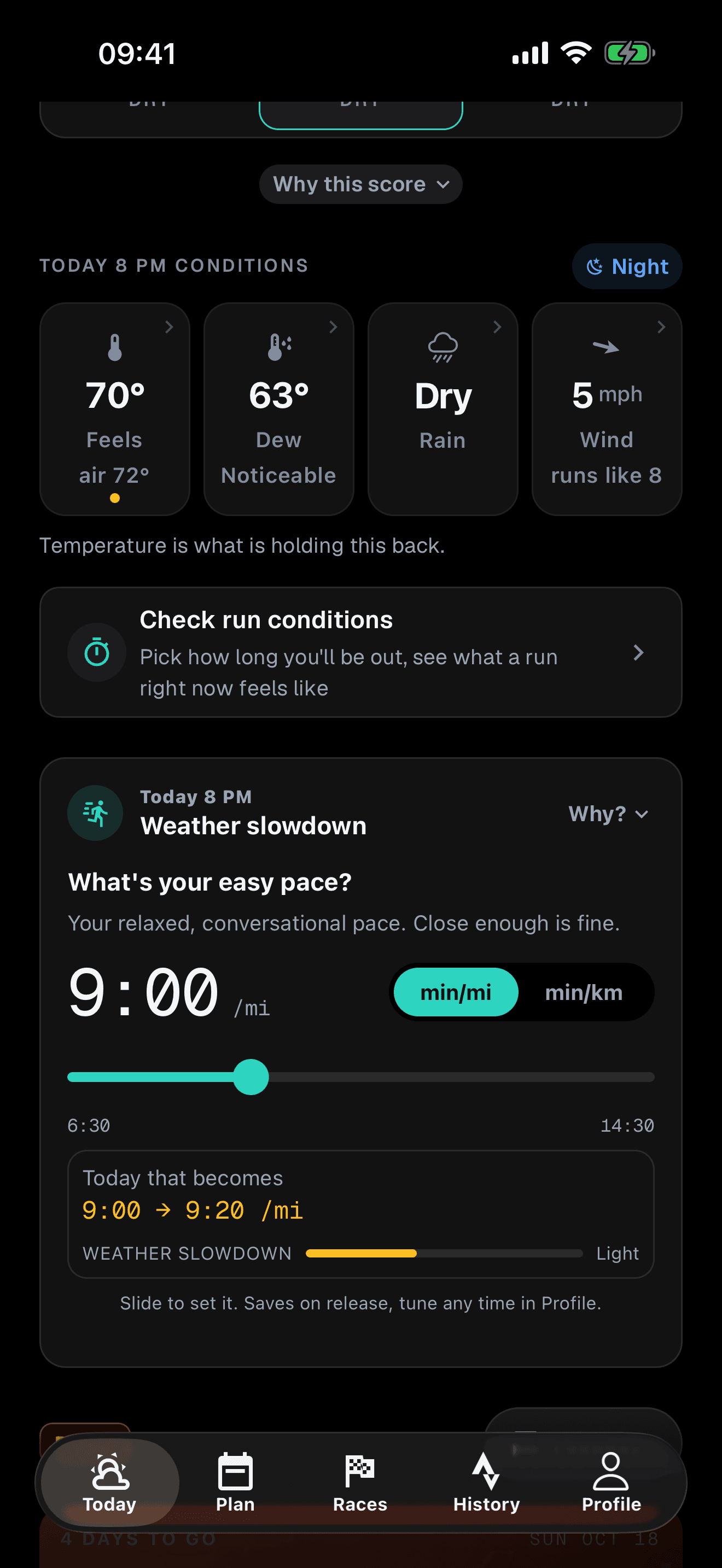
Dress for the hour you will be out, which is rarely the day's low or high. The free Run Score calculator scores the current hour and the best hour still to come for any city, with what is holding each one back, and city pages such as Chicago and Minneapolis show typical conditions month by month. In the app, the cold safety limits read the wind chill rather than the bare temperature, and that is the order to check before choosing a jacket.
The outfit you are after feels slightly too cold for the first few minutes, about right by the middle, and still dry enough at the end that the walk home is not the worst part of the run. It takes a few weeks of notes to find, it will not match your friend's, and that is fine.
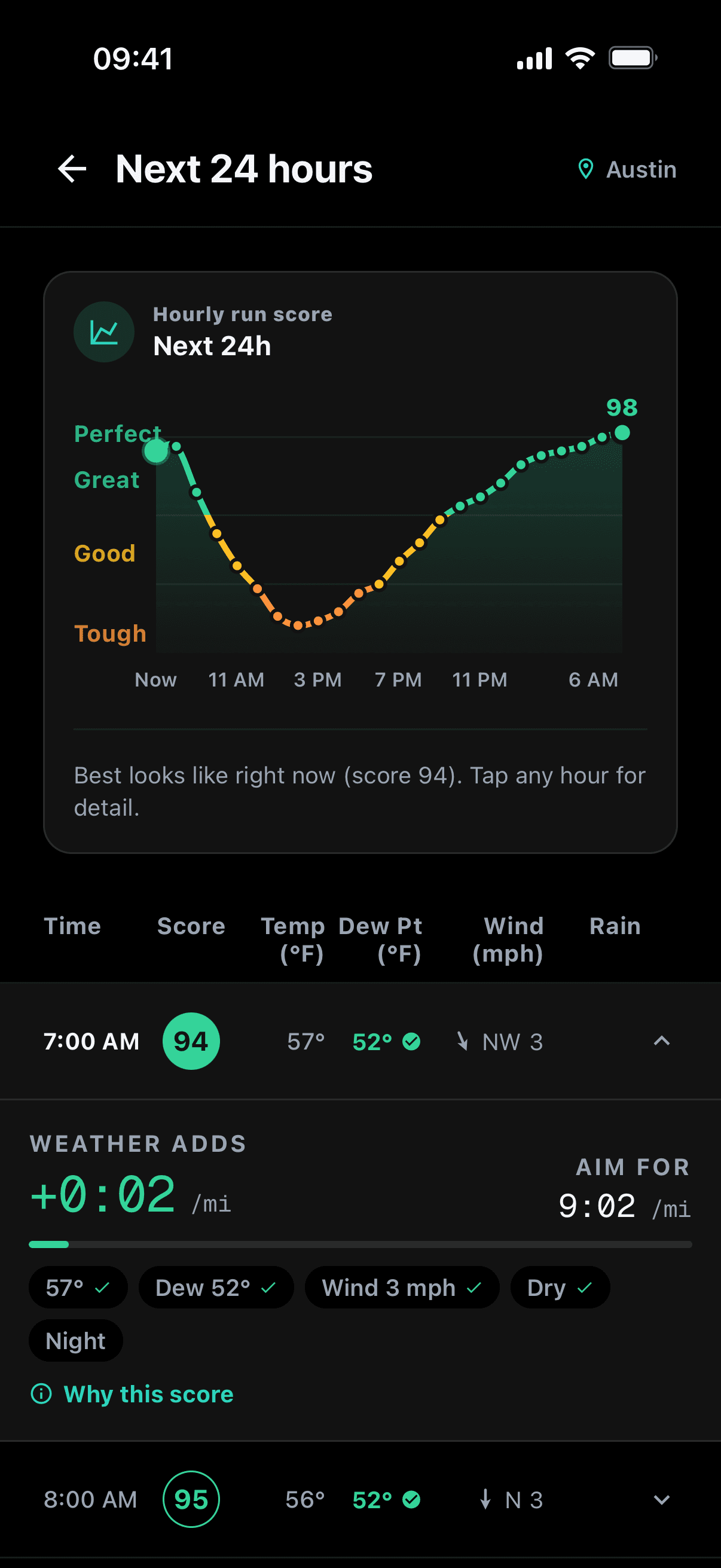

Every hour of the next day, scored, so you dress for the one you run in.
Frequently asked questions
What should I wear running in 40 degree weather?
At about 40°F (4°C), calm and dry, start with a long-sleeved top, tights or running trousers, and light gloves you can take off. Add a wind shell if the route is exposed or it is drizzling, and keep a dry layer for afterward. It is a starting point, not a tested cutoff.
What should I wear running in 30 degree weather?
At about 30°F (-1°C), start with a base layer that does not soak up sweat, a light second layer or wind shell, tights, gloves and something over the ears. Wind and pace move this more than the number does: a slow runner on an exposed route needs more than a fast runner on a sheltered loop.
What should I wear running in 20 degree weather?
At about 20°F (-7°C), most runners want a base layer, light insulation and a wind shell on top, thermal tights or two leg layers, mittens, a hat and a neck gaiter. Check the wind chill before choosing kit, because exposed fingers and cheeks freeze first.
Is the dress 15 to 20 degrees warmer rule accurate?
It is a rule of thumb, and I could not find a study behind it. It roughly fits a mid-pace runner on a calm, dry day, and it fails for slow paces, wind, rain and anything that involves standing still. The ACSM cold-weather consensus says to adjust clothing to your own sweating rather than wear a standard amount.
What should I wear running in cold rain?
A light shell over a base layer that dries fast, no cotton, and the expectation of getting wet anyway, because sweat builds up inside most shells. Cold rain takes heat from you much faster than dry air at the same temperature, so keep the run close to home and change into dry clothes the moment you stop.
Sources and further reading
- Castellani JW et al. ACSM Expert Consensus Statement: Injury Prevention and Exercise Performance during Cold-Weather Exercise (Curr Sports Med Rep, 2021), full text: University of Portsmouth repository
- Cappaert TA et al. National Athletic Trainers' Association Position Statement: Environmental Cold Injuries (J Athl Train, 2008)
- Bluestein M, Osczevski R. The basis for the new wind chill temperature chart (AMS)
- National Weather Service: Wind chill chart and definition
- Ito R et al. Effects of rain on energy metabolism while running in a cold environment (Int J Sports Med, 2013)
- CDC: Preventing hypothermia
- 2024 Adult Compendium of Physical Activities (MET values)
- Mayhew JL. Oxygen cost and energy expenditure of running in trained runners (Br J Sports Med, 1977)
- Batliner ME et al. Does metabolic rate increase linearly with running speed in all distance runners? (Sports Med Int Open, 2018)
- NHS: Frostbite
Related reading
- What to wear running: the guide for every temperature
- How cold is too cold to run?
- Running in the cold: wind chill, layers and staying safe
RunWeather is available now on the App Store and Google Play.